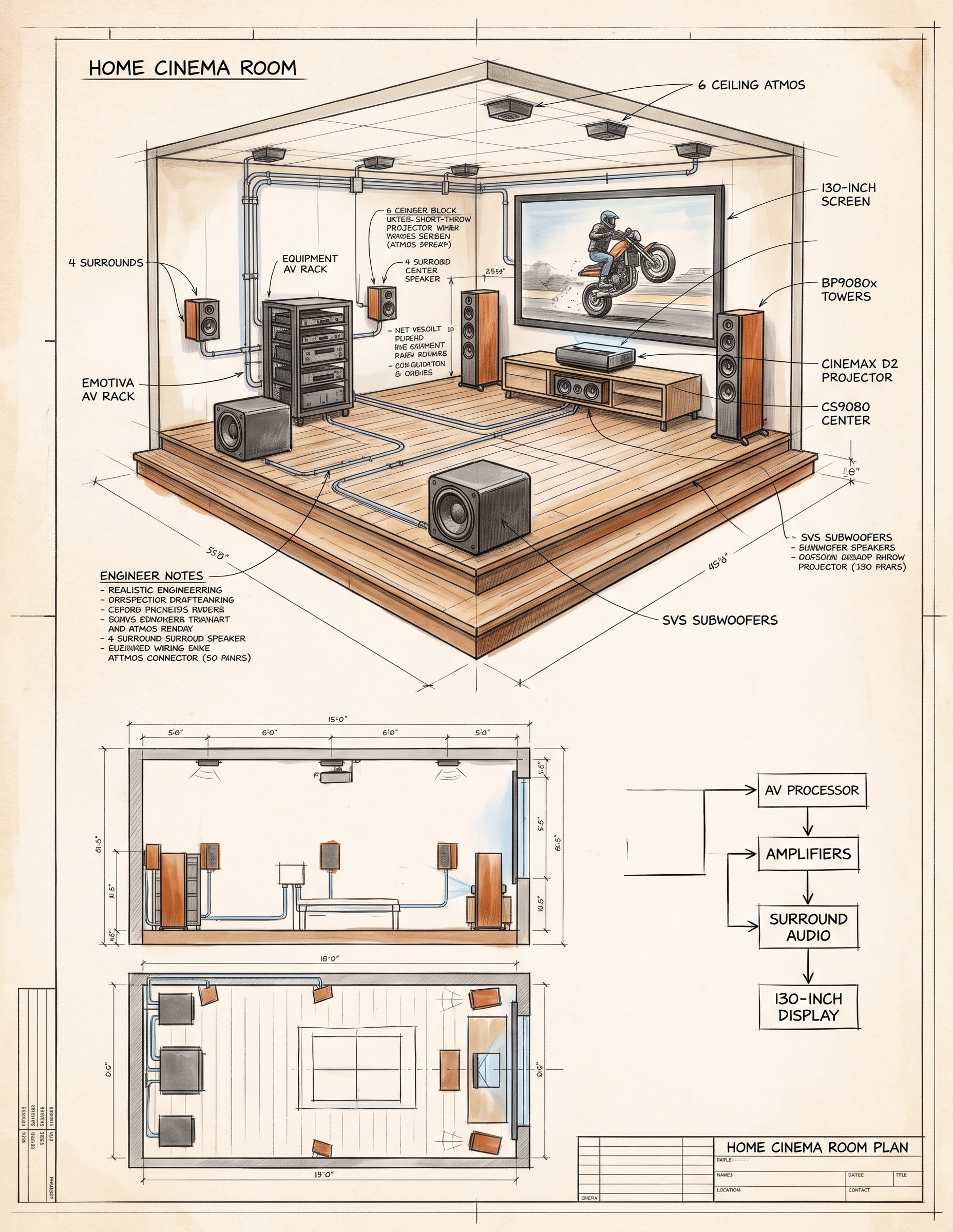
The room plan: 130-inch screen, equipment A/V rack, BP9080x towers, 4 surrounds, 6 ceiling Atmos speakers and SVS subwoofers.
Real-world facts
The architectural room plan represents the two-dimensional blueprint that coordinates listener seating positions, acoustic geometry and transducer placement within a dedicated private cinema. Room dimension ratios heavily dictate how internal standing sound waves, known as room modes, behave at low frequencies. Acoustic researchers like Dr. Floyd Toole have documented that cubic or perfectly proportional rectangular rooms suffer from severe modal pileups, where identical resonance frequencies stack together and create intense acoustic booms and nulls. Choosing dimensional ratios adhering to Sepmeyer or Bolt acoustic distribution areas spreads axial, tangential and oblique room modes evenly across the frequency spectrum, creating a balanced acoustic foundation before any digital room correction software is applied.
Seating distance from the 130-inch fixed projection screen must balance human optical acuity with immersive cinematic field of view. A 130-inch diagonal screen measuring 113 inches wide by 64 inches high provides an optimal horizontal viewing angle of 40 degrees when the primary listening position is situated at approximately 3.8 metres, or 12.5 feet, from the screen surface[1]. This 40-degree field of view aligns precisely with THX cinema guidelines, ensuring that viewers feel completely immersed in wide aspect ratio films without experiencing visual fatigue from excessive head turning[1]. In contrast, the SMPTE 30-degree standard dictates a more conservative seating distance of roughly 4.5 metres, or 15 feet[1]. Practical room designers avoid placing the seating row in the exact geometric centre of the room length, where the first axial standing wave creates a severe bass cancellation null, nor against the rear boundary wall, where boundary gain causes overpowering and muddy bass resonances. The time-tested 38 percent guideline, which recommends placing primary listener ears at approximately 38 percent of the room length measured from either the front or rear boundary, serves as an optimal starting baseline for acoustic smoothness.
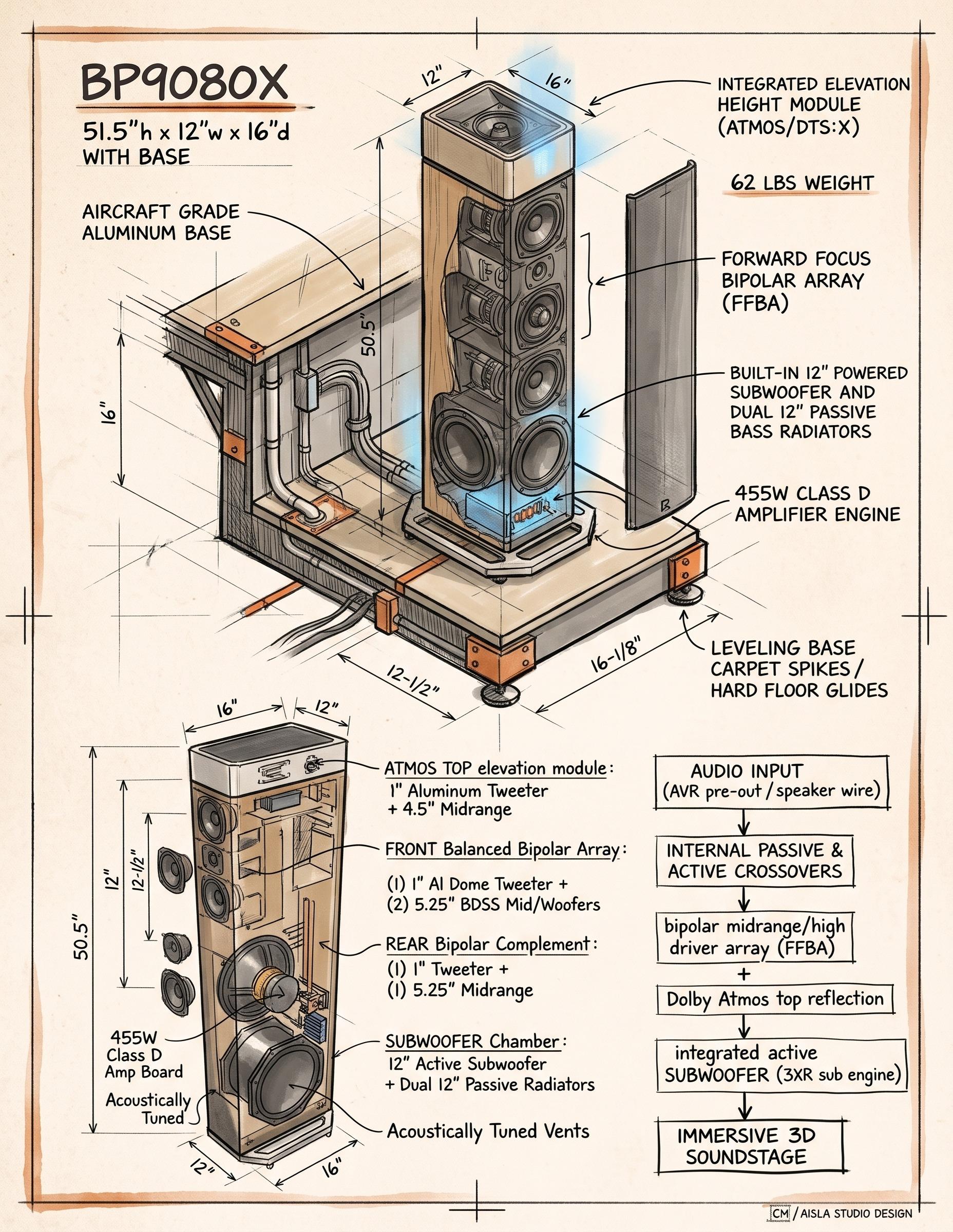
Loudspeaker positioning follows the rigorous recommendations detailed in the CEDIA and CTA RP22 standard, published in September 2023[2]. Former Dolby chief scientist Poppy Crum remarked that "standards ensure consistency of experience" across modern multi-channel playback rooms[2]. The Definitive Technology BP9080x front left and right towers are placed flanking the screen, positioned at an azimuth angle between 22 and 30 degrees off the central listening axis to create a stable stereo soundstage[2]. Because the BP9080x utilizes a forward-focused bipolar design with active rear-facing drivers, the cabinets must sit at least 45 centimetres away from the front boundary wall. This distance allows rear acoustic reflections to expand properly and blend with the front wavefront without generating destructive high-frequency comb filtering. Both towers are toed inward slightly toward the primary listening seat so their pure aluminium dome tweeters fire directly at audience ear height, located approximately 1.1 metres above the finished floor[2].
The perimeter surround channels and overhead ceiling channels are distributed geometrically to maintain seamless acoustic panning envelopes. The four surround speakers are divided into two side surrounds located between 90 and 110 degrees azimuth and two rear surrounds located between 135 and 150 degrees azimuth[2]. Positioned slightly above seated ear height to clear high recliner headrests, they form a continuous horizontal ring of sound. Overhead, the six Dolby Atmos ceiling speakers are aligned into three distinct pairs: Top Front, Top Middle and Top Rear[2]. These ceiling speakers are mounted in line with the front tower channels, suspended at elevation angles of roughly 45 degrees forward, 80 degrees overhead and 135 degrees rearward relative to the reference seat[2]. This overhead grid conforms to RP22 Level 2 criteria, providing seamless three-dimensional trajectories for sound effects moving through room airspace.
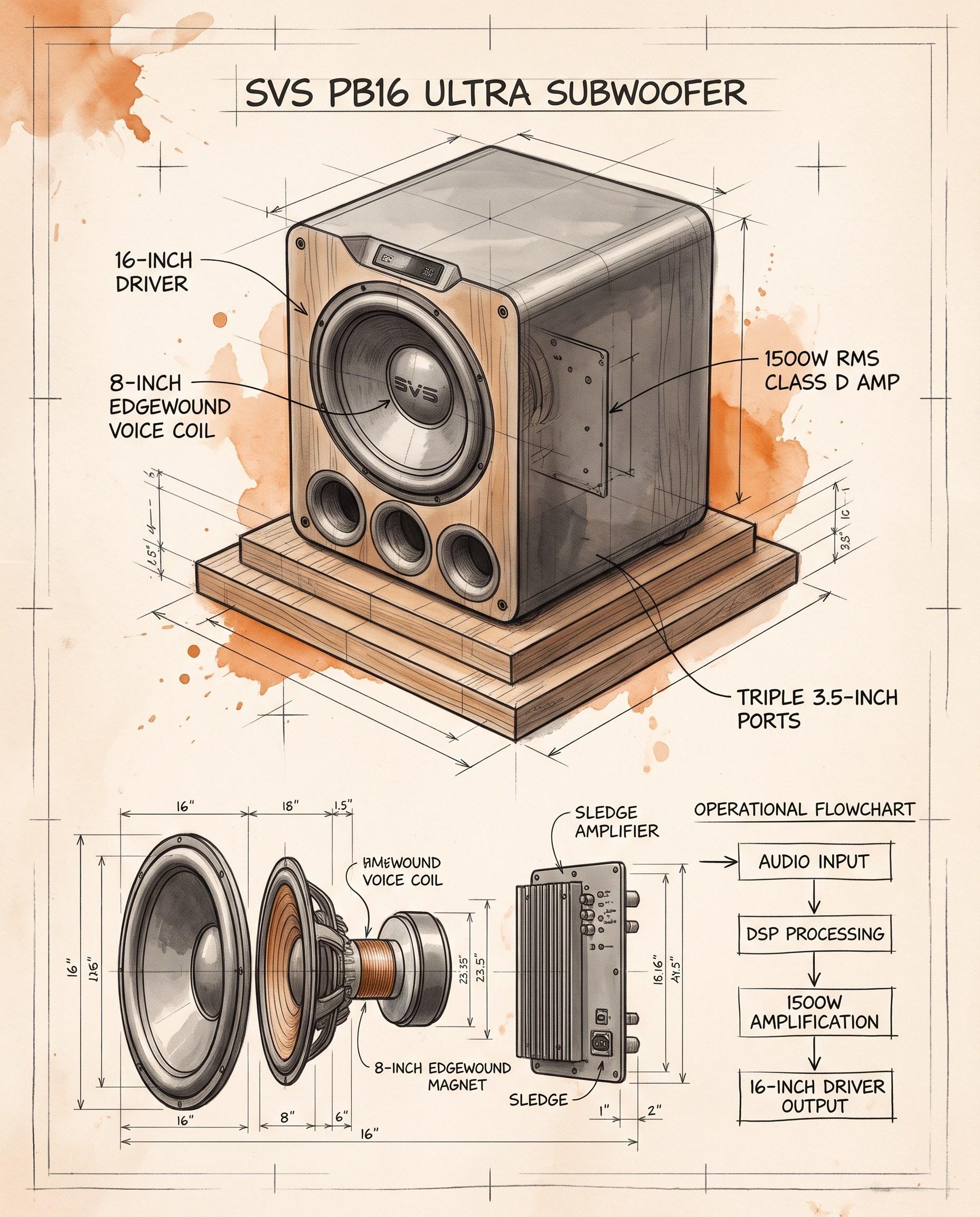
Subwoofer placement in the room plan addresses low-frequency room mode cancellation through distributed multi-subwoofer engineering. Placing heavy SVS ported subwoofers in opposing boundary positions, such as the midpoints of the front and back walls or opposing diagonal corners, effectively cancels out odd-order axial room modes. Audioholics notes that dual subwoofers "improve the consistency of the bass response throughout multiple seats" rather than simply increasing overall sound volume[3]. The equipment A/V rack is purposefully drafted outside the primary viewing zone, positioned in a recessed side alcove or utility closet. This isolation keeps humming transformer vibrations, fan whir and glowing equipment displays from degrading the audience's sensory immersion.
Specifications on the drawing
- 130-inch screen: A fixed 16:9 projection surface positioned symmetrically on the front room boundary. It dictates the reference seating distance of 3.8 metres to achieve an optimal 40-degree field of view that immerses the viewer without causing eye strain.
- Equipment A/V rack: A dedicated electronics cabinet located in a recessed alcove outside the primary viewing and listening envelope. This strategic placement isolates distracting front-panel light displays, mechanical cooling fan noise and equipment heat away from the audience seats.
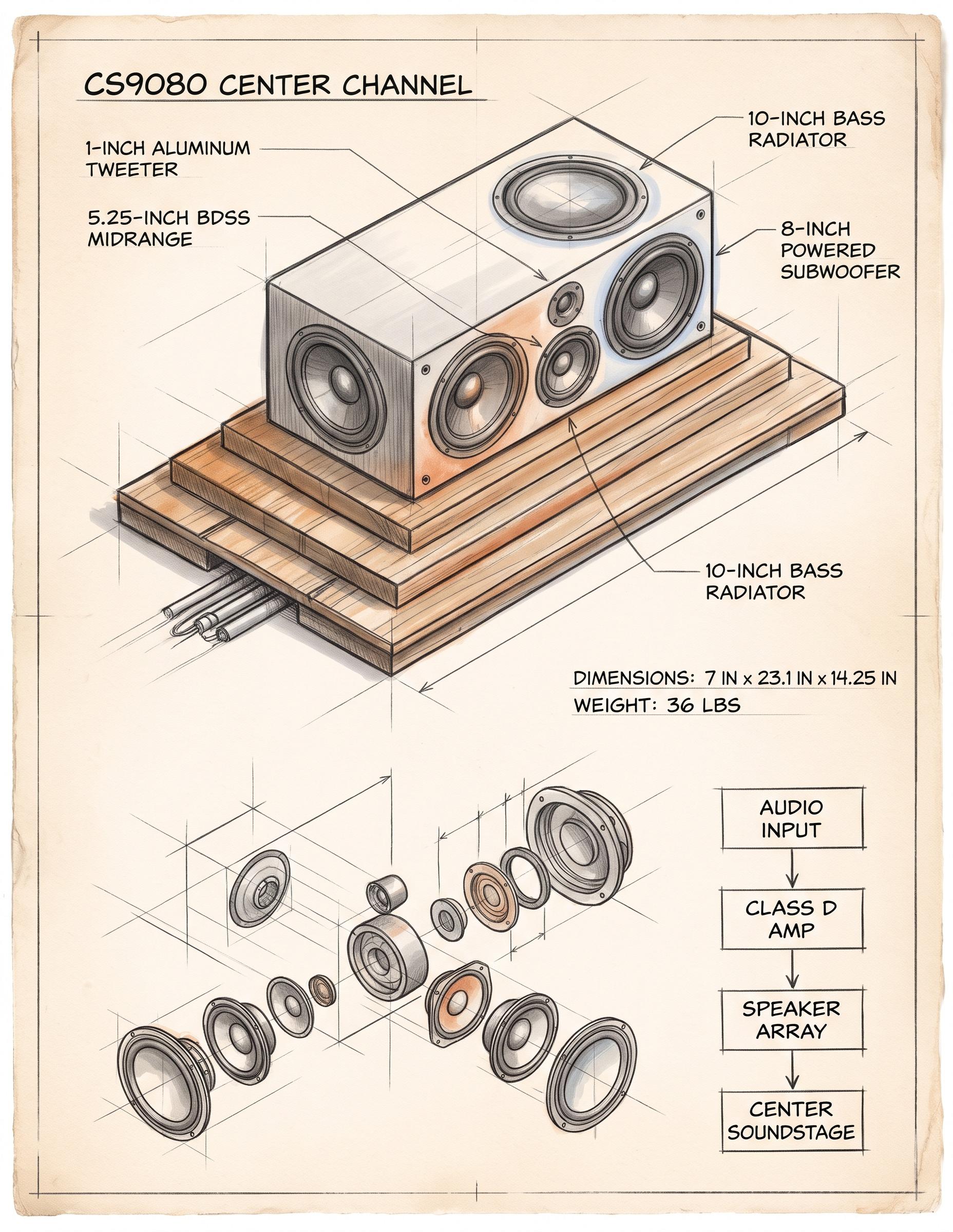
- BP9080x towers: Floorstanding front speakers positioned at 22 to 30-degree angles off the room's central axis and pulled 45 centimetres forward from the front boundary. This precise placement allows the bipolar rear-firing drivers to disperse naturally across the wall while focusing pristine stereo imaging directly at the reference seat.
- 4 surround speakers: Four perimeter loudspeakers arranged as lateral side pairs at 90 to 110 degrees and rear pairs at 135 to 150 degrees relative to listener ears. They complete the 360-degree horizontal soundstage, ensuring that environmental ambient cues and moving sound effects transition smoothly around the listener.
- 6 ceiling Atmos speakers: A six-channel overhead speaker array positioned in three parallel pairs above the listening area at specific elevation angles of 45, 80 and 135 degrees. This overhead matrix delivers discrete vertical sound localization, accurately rendering high-altitude audio effects like thunder, helicopters and falling rain.
- SVS subwoofers (write about room layout, seating distance, speaker and subwoofer placement): Dual high-output powered subwoofers situated at opposing room boundary midpoints to cancel destructive room standing waves. This multi-subwoofer placement strategy eliminates acoustic bass nulls and seat-to-seat frequency variations, ensuring that every listener experiences smooth, tactile low-frequency impact.
Sources
- Modenese Bespoke, Home Cinema Seating Layout & Sight-Line Guide
- OpenHomeAV, Dolby Atmos Speaker Placement Calculator
- Audioholics Forums, Subwoofer: Single or Double?