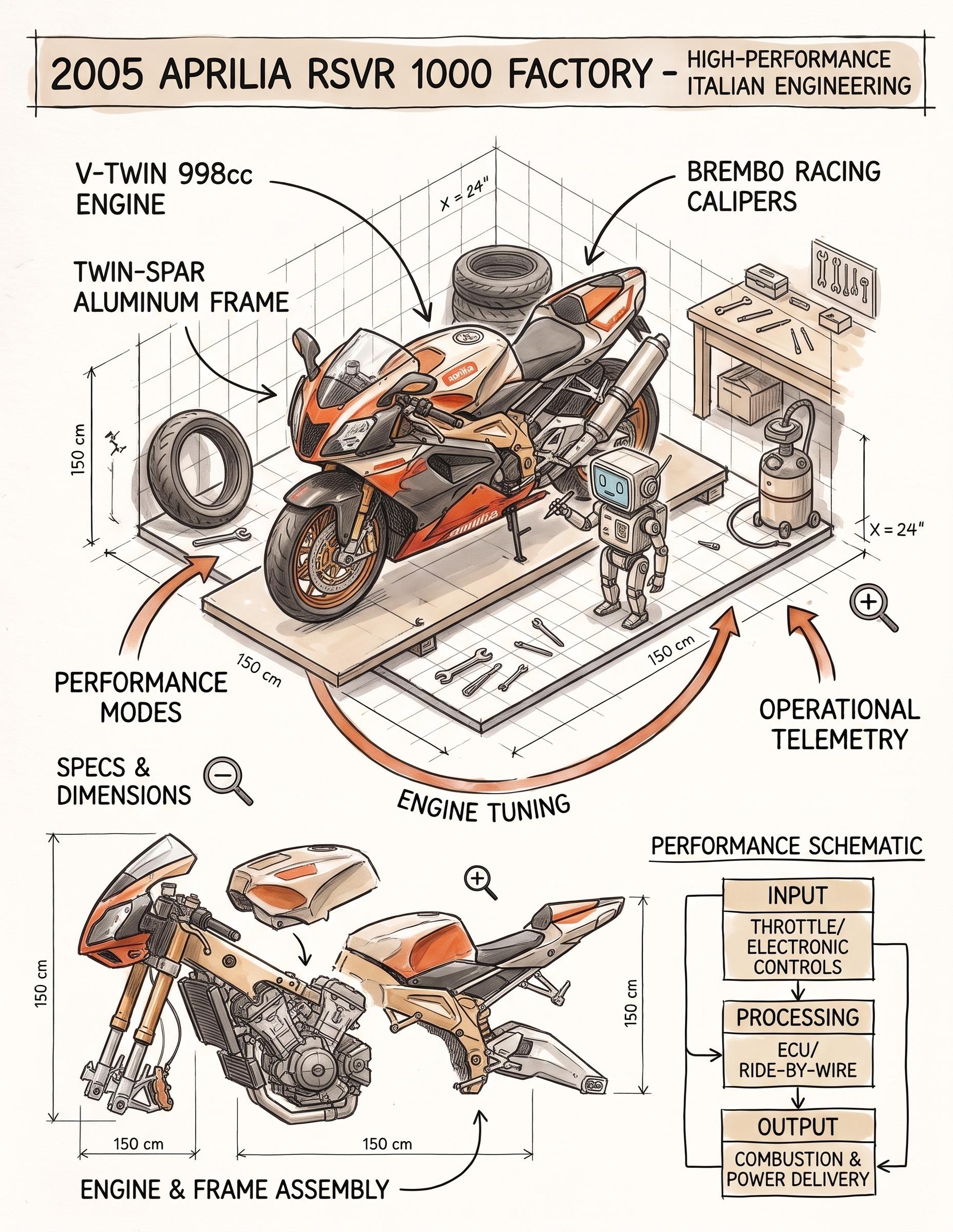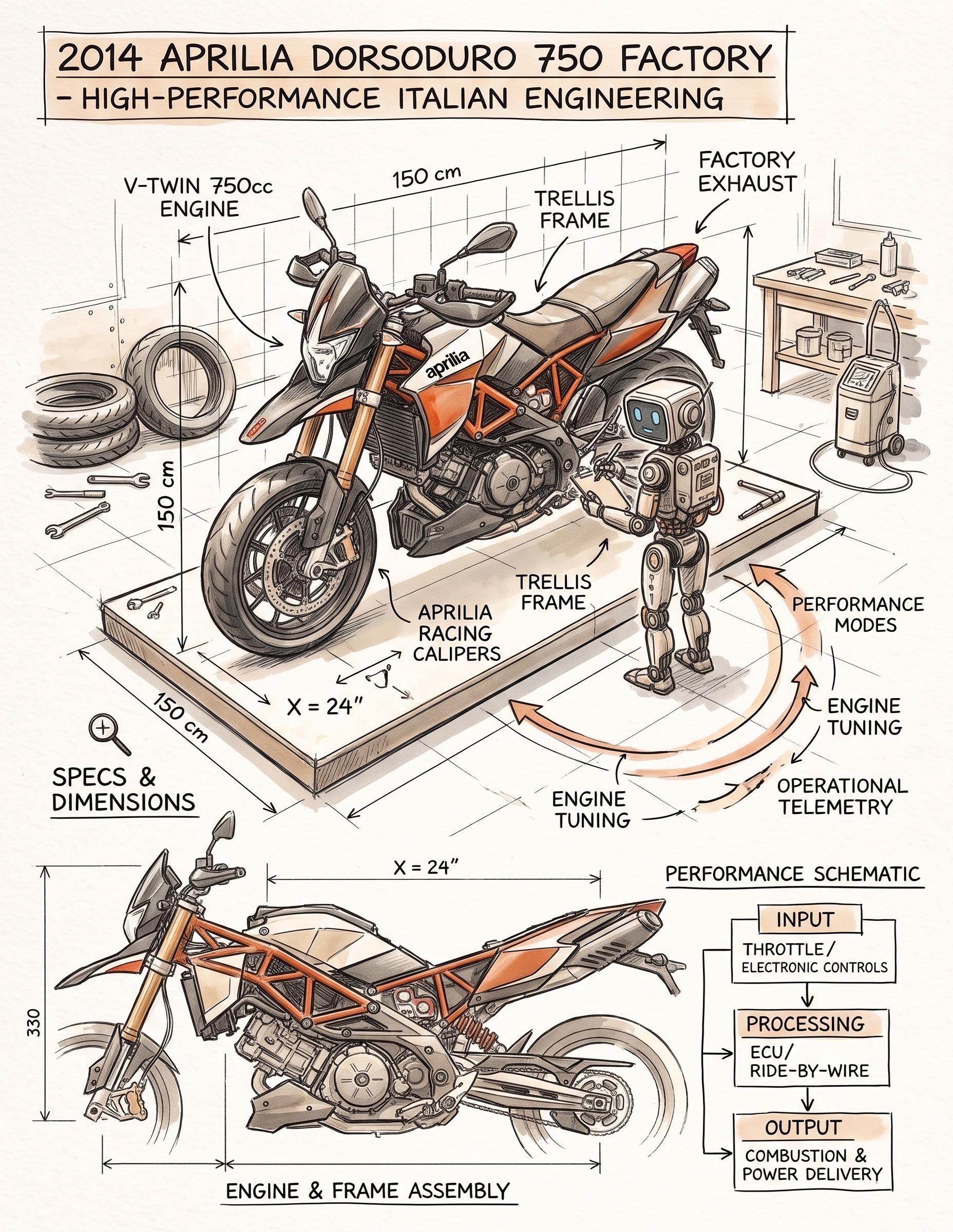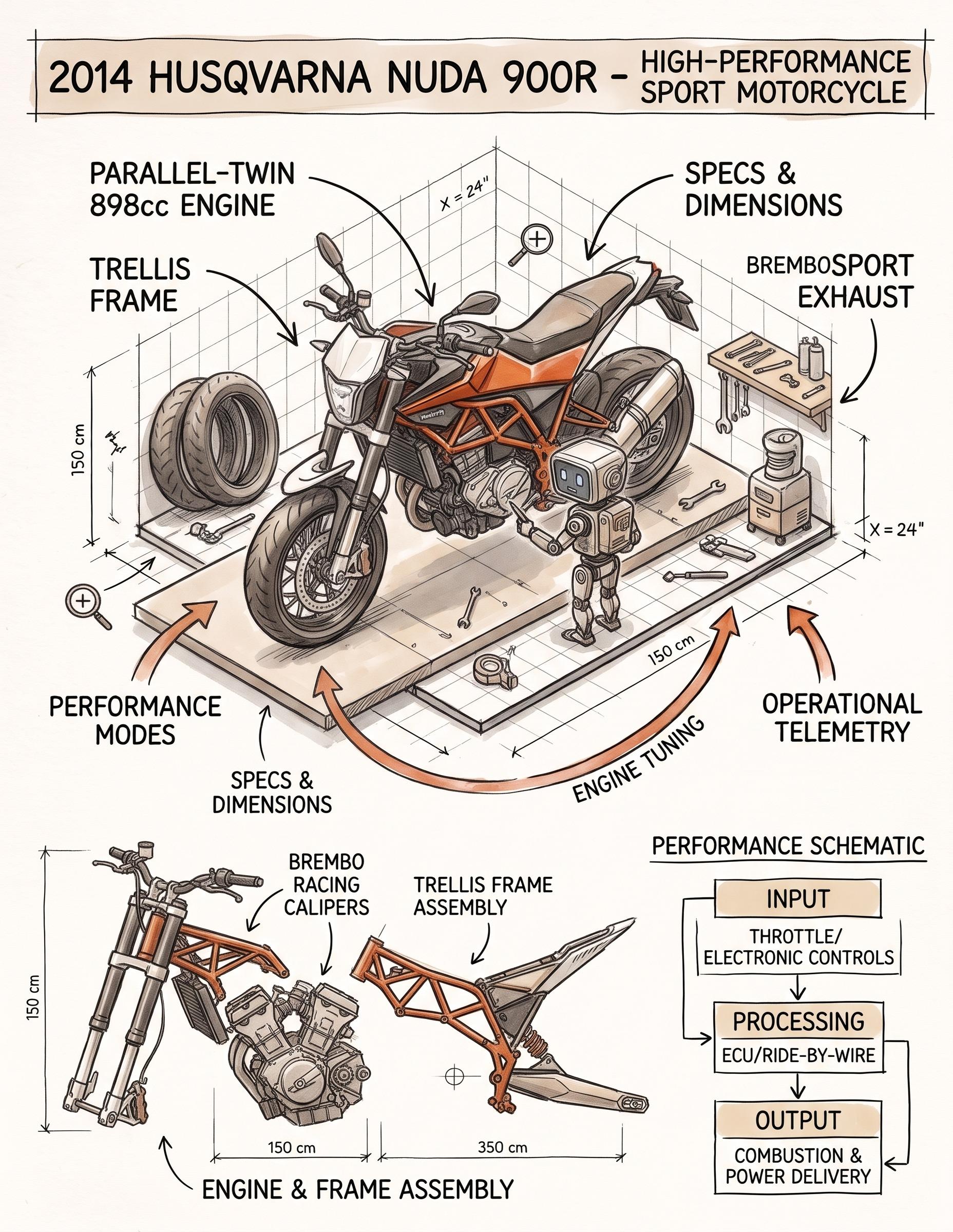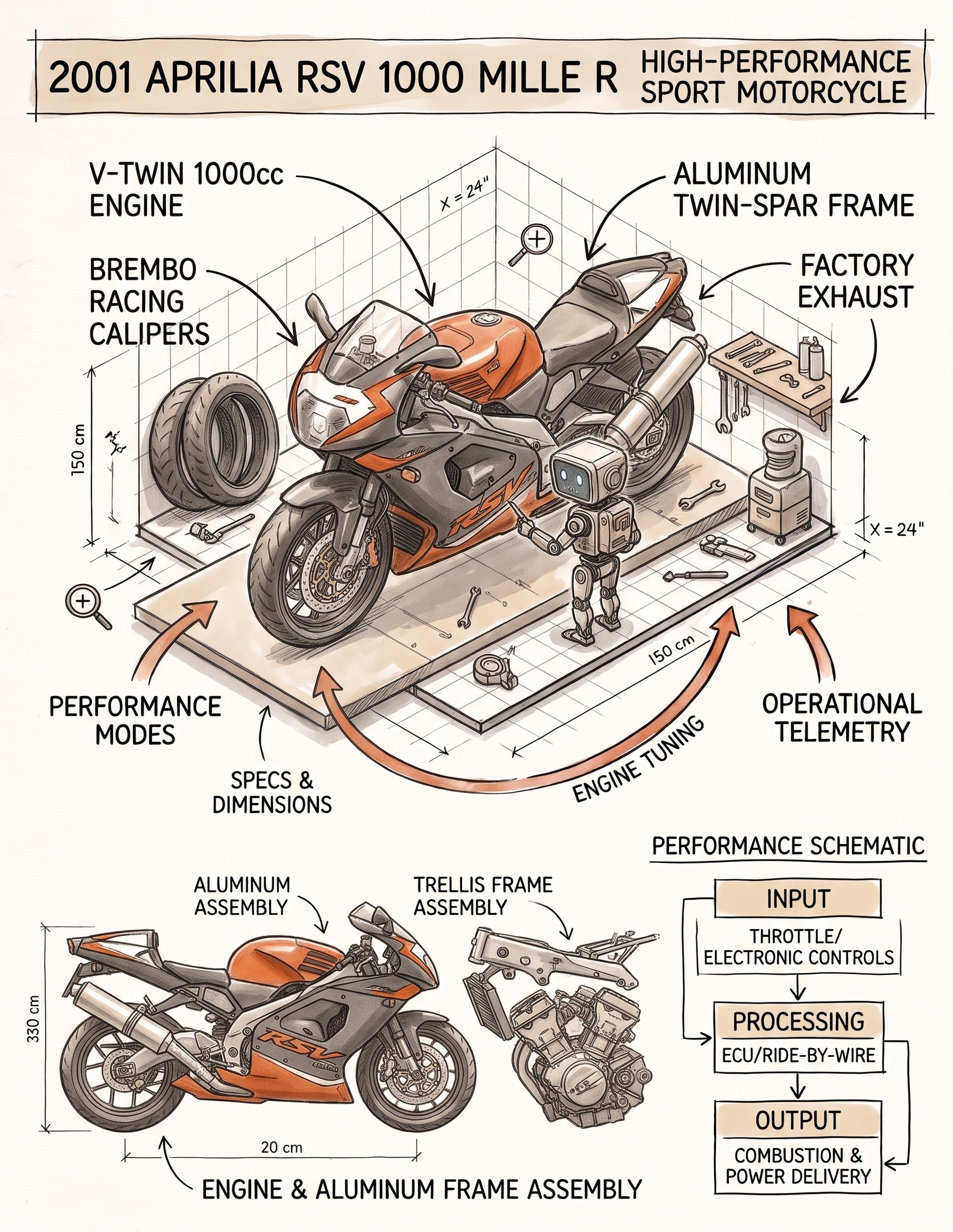
V-twin 1000cc, Brembo racing calipers, aluminum twin-spar frame and a factory exhaust.
Real-world facts
Italian superbike engineering at the turn of the millennium was defined by high-displacement V-twins battling in the World Superbike Championship. Aprilia shook up the established order in 1998 by introducing the RSV Mille, mounting an immediate technical challenge to Ducati's dominance[1]. By 2000, Aprilia introduced the up-spec Mille R, and in 2001, the machine received a comprehensive redesign featuring over two hundred modified components[2]. In Canada, the 2001 Aprilia RSV 1000 Mille R carried an original launch price of CA$19,995[3]. Built in Noale, Italy, the Mille R offered privateers and road riders a turn-key competition platform equipped with exotic components straight from the showroom floor[2].
The beating heart of the machine is its liquid-cooled 998cc 60-degree V-twin engine, engineered and manufactured in partnership with Austrian specialist BRP-Rotax[2]. Unlike standard 90-degree V-twins that require a long wheelbase to prevent the front cylinder from intruding into the front wheel space, the narrow 60-degree V angle allowed Aprilia to engineer an exceptionally compact powerplant[1]. To cancel the inherent primary mechanical vibrations of a 60-degree cylinder layout, Rotax integrated patented dual counter-rotating balance shafts, known as the Advanced Balancing Vibration Canceler or AV&C[2]. For the 2001 model year, Aprilia revised the cylinder heads, enlarged the intake valves by 2 mm, increased camshaft lift by 0.8 mm and broadened the intake throttle bodies to 57 mm[2]. These revisions lifted factory output to 130 horsepower at 9,500 rpm and 75 foot-pounds of torque at 7,250 rpm[2].
I rode this specific 2001 Aprilia RSV 1000 Mille R for several years through British Columbia, and the chassis composure remains extraordinary across mountain passes. The frame is a polished aluminium twin-spar perimeter design fabricated from cast and extruded alloy sections, mated to an asymmetric banana-style aluminium swingarm engineered to clear the upswept exhaust canister[2]. Cycle World highlighted this balance in their retrospective review, writing that "nothing short of a giant cedar strewn across the road upsets the chassis". The Mille R differentiated itself from the base Mille by substituting standard Showa suspension for fully adjustable 43 mm titanium-nitride coated Öhlins upside-down front forks, an Öhlins rear monoshock and an adjustable Öhlins steering damper[2].
Braking performance was upgraded in 2001 to Brembo's Gold Series racing package[2]. The front setup features dual 320 mm stainless steel floating discs clamped by Brembo four-piston, four-pad differential calipers[2]. By dedicating one independent sintered friction pad to each piston rather than sharing two long pads across four pistons, Brembo achieved sharper initial bite, even pad pressure and superior heat dissipation during heavy track use[2]. Motorcyclist reviewed the updated Mille R and remarked that "the front brakes offer monstrous stopping power". Light blue anodized forged aluminium OZ Racing wheels came standard on the R variant, slashing unsprung rotating mass by over 4.5 kilograms compared to the base three-spoke cast wheels, allowing the bike to transition side to side with razor-sharp agility[2].
The factory exhaust system utilized a large-volume stainless steel collector feeding into an oval brushed aluminium silencer positioned high on the right side[2]. While meeting European emissions and sound limits, the factory canister tuned the Rotax engine's acoustic pulse into a deep, booming bass note that resonated cleanly across the rev range[2]. To shave further weight, the Mille R replaced painted plastic fairing trim with genuine autoclave-cured carbon fibre parts, including the front mudguard, rear tire hugger, dashboard surround and aerodynamic fairing side extractors[2]. Dry weight stood at an athletic 183 kilograms, or 403 pounds, making it one of the lightest production V-twins of its era[2].
Living with an early Mille R involves understanding its unique mechanical quirks and maintenance requirements[1]. The 60-degree Rotax engine relies on an external dry-sump oiling system, requiring owners to warm the oil completely before checking the clear sight tube on the left flank[1]. On owner forums like ApriliaForum, riders emphasize the vulnerability of the sprag clutch starter gear[4]. If the battery voltage drops even slightly, attempting to crank the high-compression 97 mm pistons causes the starter sprag to slip, eventually rounding off its internal pawls and requiring an expensive replacement[4]. Enthusiasts routinely install heavy-gauge battery wiring kits and keep the motorcycle on a continuous battery tender to ensure rapid starter spin[4].
Specifications on the drawing
- V-twin 1000cc engine (998cc Rotax 60-degree): A liquid-cooled, four-stroke, eight-valve twin-cylinder powerplant developed by Rotax in Austria with cylinders arranged at a compact 60-degree angle (sources vary: displacement is precisely 997.6cc, rounded commercially to 998cc or 1000cc). The tight cylinder bank allows a shorter wheelbase and centralized chassis mass, while integrated balance shafts cancel vibrations and deliver broad, tractable low-end torque. This engineering architecture allows riders to drive out of slow hairpins with immediate mechanical grip without having to dance frantically on the gear shift lever.
- Brembo racing calipers: Gold Series four-piston, four-pad differential hydraulic brake calipers clamping onto dual 320 mm floating stainless steel front discs. Each brake piston pushes its own individual sintered friction pad, giving the rider immense stopping deceleration, consistent lever feedback and zero brake fade during aggressive riding. This dedicated pad layout spreads heat evenly across the steel rotor surface, preventing hydraulic fluid boiling during repeated heavy braking.
- Aluminium twin-spar frame: A lightweight structural chassis fabricated from cast and extruded box-section aluminium alloy beams that bridge the steering neck directly to the swingarm pivot. It provides immense torsional rigidity under high cornering loads while keeping overall dry weight down to 183 kilograms for telepathic handling response. The structural stiffness ensures the motorcycle tracks with absolute precision across uneven pavement mid-corner without flexing or oscillating.
- Factory exhaust: The original high-clearance stainless steel header network routed into a large-volume upswept brushed aluminium silencer on the right flank. It maintains correct engine scavenging back-pressure for mid-range torque delivery while emitting a deep, resonant V-twin exhaust note within legal road noise standards. The upward sweep is tucked tightly inside the motorcycle centreline to maximize cornering lean clearance on racetrack kerbs.
Sources
- Bennetts BikeSocial, Aprilia RSV1000 Mille (1998-2003) Review and Buying Guide
- Motorcycle Specs, 2001 Aprilia RSV 1000 Mille R Technical Guide
- Bikez, 2001 Aprilia RSV Mille R Specifications and Pricing
- ApriliaForum, RSV Mille Sprag Clutch and Maintenance Essentials
Product page: Aprilia