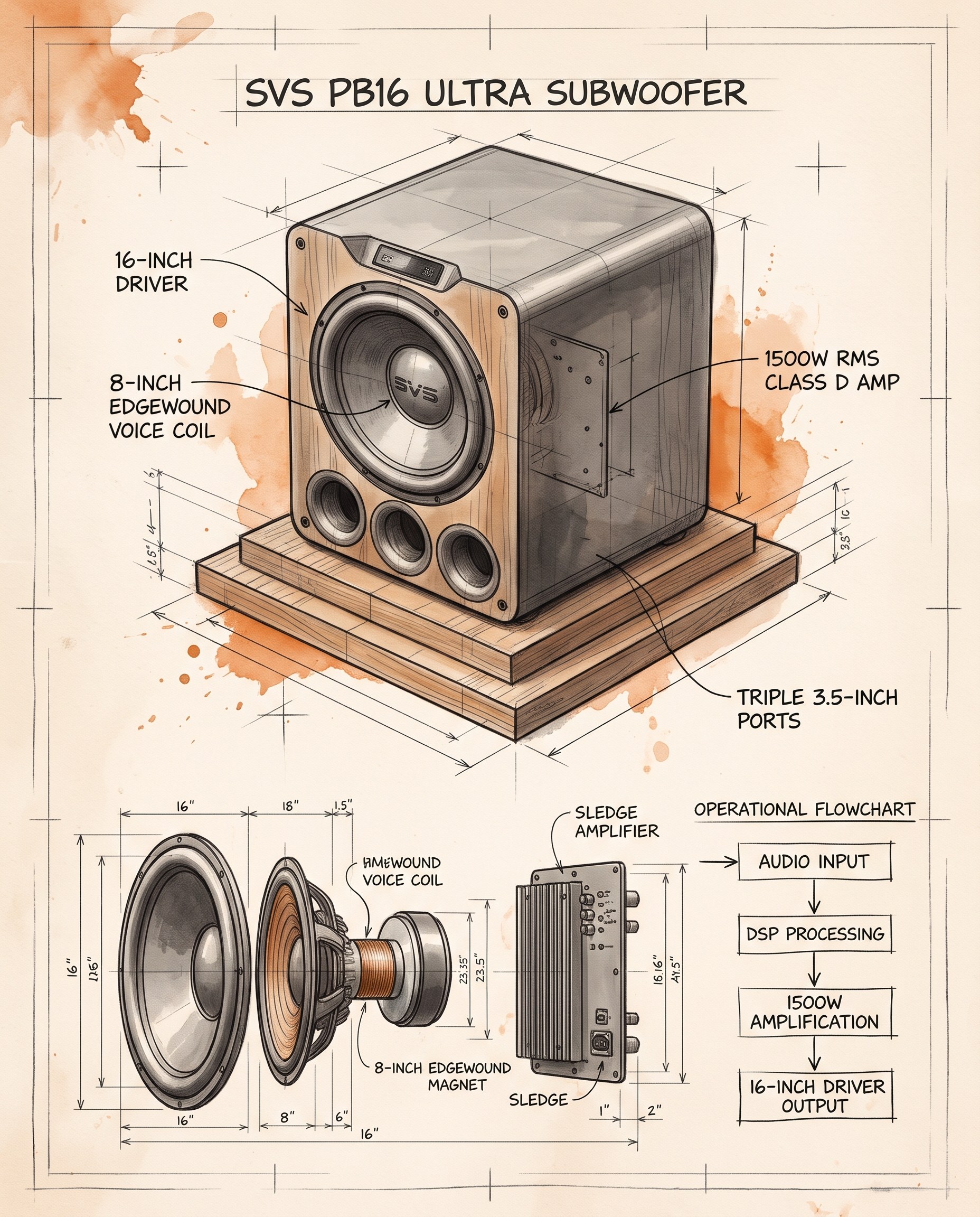
16-inch driver with an 8-inch edgewound voice coil, a Sledge Class D amplifier and triple 3.5-inch ports in a big ported cabinet for deep bass.
Real-world facts
In the realm of cinematic low-frequency reproduction, few components command as much respect and awe as the SVS PB16-Ultra. Founded in 1998 in Youngstown, Ohio, SVS established itself as a premier direct-to-consumer subwoofer brand, evolving from cylindrical enclosures to reference-grade box subwoofers. In November 2016, SVS unveiled its groundbreaking 16-Ultra series, headlined by the ported PB16-Ultra at a launch price of CA$3,499[1]. The PB16-Ultra was engineered from scratch over several years to displace air with unprecedented physical force while maintaining lightning-fast transient speed and low harmonic distortion[2]. It immediately claimed top honours across the audio industry, earning the prestigious EISA Award for Best Home Theatre Subwoofer in 2017[3].
The acoustic powerhouse inside the PB16-Ultra is a proprietary 16-inch high-excursion driver[1]. The cone is fabricated from an ultra-light, rigid fibreglass resin composite that preserves structural stiffness under immense internal pressures[1]. Driving this massive cone is an unprecedented 8-inch edge-wound voice coil, which SVS noted was the largest voice coil ever deployed in a consumer residential subwoofer[1]. Utilizing four massive toroidal ferrite magnets, this motor structure weighs over 50 pounds on its own, providing colossal magnetic flux that allows continuous linear cone travel exceeding three inches peak-to-peak[2]. This engineering triumph guarantees that even during seismic infrasonic frequencies, the voice coil remains completely controlled within the magnetic gap without bottoming out[2].
Powering this transducer is an advanced Sledge Class D amplifier module, rated at 1,500W continuous RMS with over 5,000W peak power [1, 4]. The amplifier utilizes discrete MOSFET output transistors capable of dumping immense instantaneous current through the voice coil without thermal compression[1]. Audioholics subjected the PB16-Ultra to rigorous outdoor ground-plane CEA-2010 acoustic testing, observing that "SVS has taken clean deep bass to another level"[2].
Digital signal processing is managed by a high-speed Analog Devices DSP running as a 50MHz chip with 56-bit double-precision filtering [1, 5]. This DSP monitors incoming audio signals and driver excursion in real time, serving as an indestructible protective limiter while providing extensive user control[1]. SVS revolutionized subwoofer calibration with the 16-Ultra series by introducing a dedicated Bluetooth smartphone app[1]. Users can sit in their primary listening chair and fine-tune volume, low-pass filter slopes, parametric equalization and phase adjustments in real time while watching a movie scene[1].
The physical enclosure of the PB16-Ultra is built to commercial industrial proportions. The cabinet measures 25 inches high, 21.7 inches wide and 30.9 inches deep with its curved non-resonant steel mesh grille installed, weighing an astonishing 174.5 pounds[1]. Constructed from double-thickness medium-density fibreboard and reinforced with extensive internal bracing, the cabinet remains acoustically dead even when pressurizing room airspace[1]. The front baffle features three massive 3.5-inch flanged bass reflex ports[1]. By inserting the included dense foam port bungs, owners can configure the subwoofer in three distinct acoustic tuning profiles: Standard Mode with all ports open extending down to 15 Hz, Extended Mode with two ports open reaching down to a subterranean 13 Hz, or Sealed Mode with all ports blocked[1].
In real-world room installations, handling and tuning a subwoofer of this size requires careful strategy[2]. Moving the PB16-Ultra unassisted is almost impossible without risking injury or damaging floors, prompting owners on AVS Forum to recommend furniture glide pads or having two people maneuver the cabinet[4]. Decoupling the subwoofer from floorboards using SVS SoundPath elastomer isolation feet prevents powerful bass vibrations from traveling mechanically into house framing[4]. Furthermore, running dual PB16-Ultra units placed at opposing room boundary midpoints smooths out acoustic standing wave nulls, providing every theatre seat with seamless, bone-rattling infrasonic impact[2].
The subwoofer connects effortlessly into professional and residential installations via balanced XLR and unbalanced RCA stereo inputs and line-level passthrough outputs[1]. These balanced XLR connections reject ground loops and common-mode electrical hum, which is critical when long cable runs stretch from an A/V rack across the cinema room[1]. SVS also incorporated an angled front-panel blue LED display hidden behind the top grille edge, allowing listeners to visually monitor volume and EQ adjustments directly from their seat[1].
Specifications on the drawing
- 16-inch high-excursion driver, 8-inch voice coil: A colossal low-frequency transducer pairing a lightweight fibreglass resin cone with an industry-first 8-inch edge-wound voice coil. This massive driver assembly pushes tremendous volumes of air across more than three inches of linear peak-to-peak travel without mechanical distortion or loss of magnetic control.
- 1,500W RMS Class D amplifier: A high-output Sledge STA-1500D amplifier delivering colossal electrical current into the massive voice coil. SVS rates it at 1,500W continuous RMS and over 5,000W peak.
- 50MHz DSP: A high-performance Analog Devices digital signal processor running 56-bit double-precision algorithms to sculpt frequency response and enforce active driver protection limits.
- Bass extension to 15Hz: The deep low-frequency acoustic boundary where the subwoofer reproduces sound down to 15 cycles per second in its standard three-port configuration (and down to 13 Hz in extended two-port mode). This reaches deep into the infrasonic tactile spectrum below human hearing, allowing viewers to physically feel atmospheric pressure changes, earthquakes and cinematic explosions inside their chests.
Sources
- SVS Sound, PB16-Ultra Ported Subwoofer Specifications
- Audioholics, SVS PB16-Ultra Ported Subwoofer Review
- EISA, European Home Theatre Subwoofer 2017-2018: SVS PB16-Ultra
- AVS Forum, SVS PB16-Ultra Thread
Product page: SVS