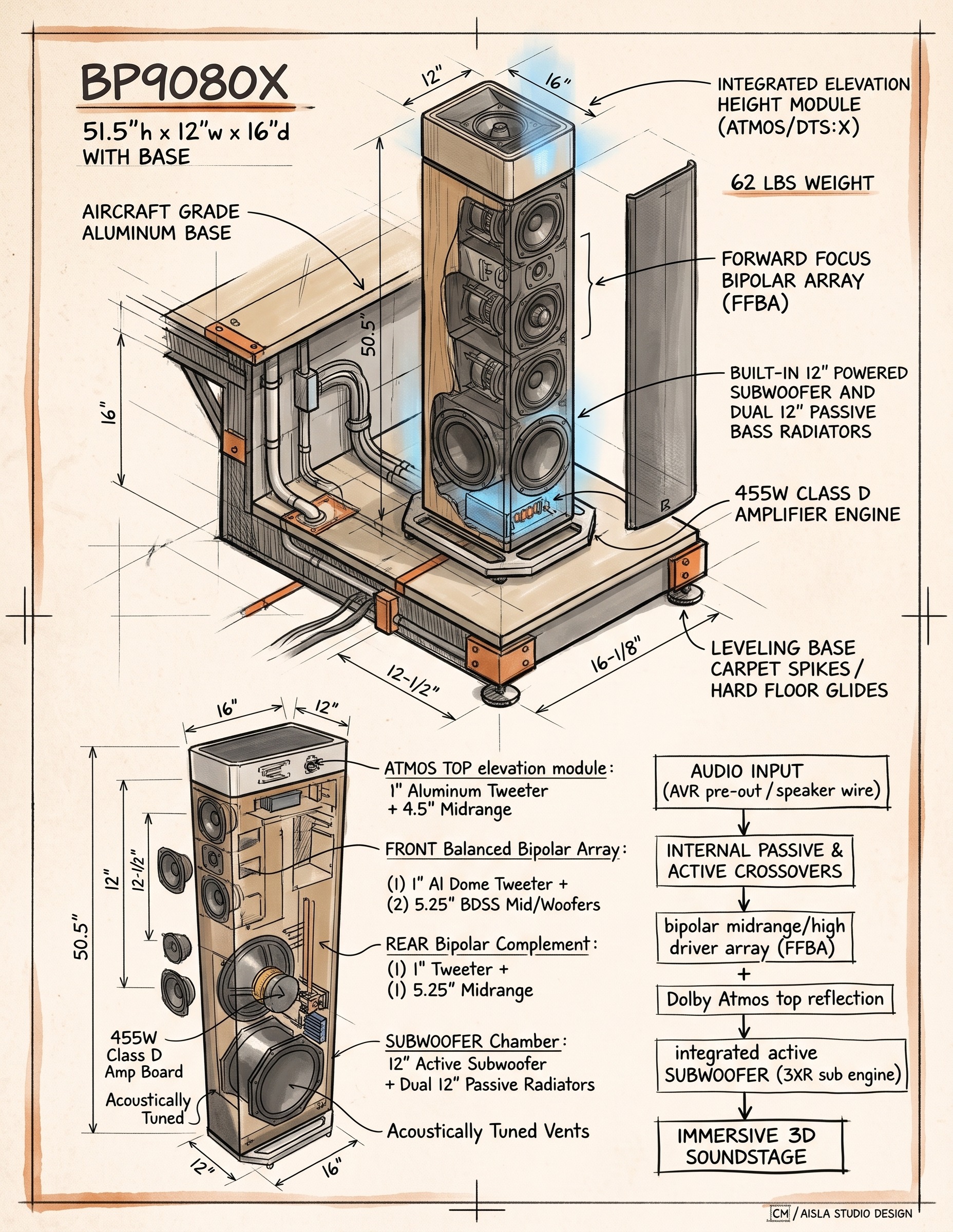
Bipolar tower with integrated Atmos height module, built-in 12-inch powered subwoofer and a 455W Class D amplifier.
Real-world facts
Tower loudspeakers occupy a distinct place in home audio, but Definitive Technology fundamentally re-engineered the category by integrating powered subwoofers directly into the speaker enclosures. Founded in 1990 by Sandy Gross, Don Givogue and Ed Blaise, Definitive Technology established itself through its signature bipolar radiator designs. The BP9000 Series made its global debut in May 2016, positioned as the fourth generation of Definitive's flagship bipolar lineup. At the apex of this lineup sat the BP9080x, commanding a retail launch price of CA$4,700 per pair in Canada. It was conceived as an all-in-one acoustic monument capable of reproducing full-range cinema sound while eliminating the visual footprint of separate outboard subwoofers and top-mounted height modules[1].
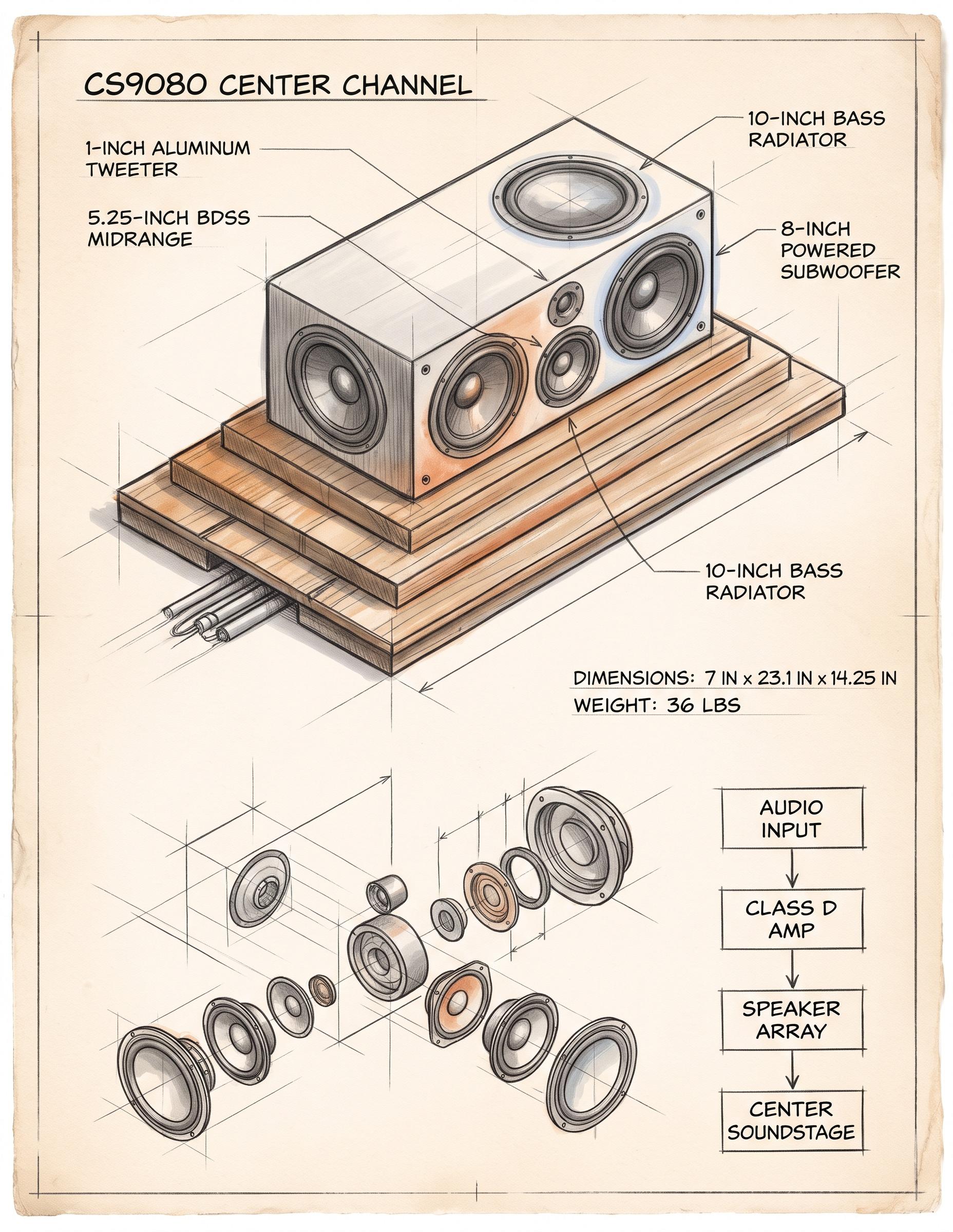
The acoustic signature of the BP9080x is driven by Definitive's Forward-Focused Bipolar Array, or FFBA. Unlike omnidirectional or symmetrical dipolar speakers that fire out of phase, the BP9080x places drivers on both the front and rear baffles that radiate in phase, with the front array biased to deliver roughly six decibels more output than the rear array[1]. The front baffle houses two 5.25-inch midrange drivers utilizing Definitive's patented Balanced Double Surround System, or BDSS, surrounding a 1-inch annealed aluminium dome tweeter. The rear baffle carries a matched 1-inch aluminium dome tweeter and a single 5.25-inch BDSS midrange driver. Sound & Vision praised this spatial configuration, noting that "the soundstage is crazily deep but still impressively focused"[1].
Bass performance is what truly sets the BP9080x apart from conventional passive floorstanders. Rather than relying on outboard amplification to drive lower frequencies, each tower houses an active, integrated 12-inch front-firing subwoofer coupled acoustically to dual 12-inch passive bass radiators mounted on opposing side panels. This driver trio is energized by an internal 455-watt Class D amplifier monitored by intelligent digital signal processing (sources vary: some third-party spec sheets list the bass amplifier at 300W continuous RMS while Definitive Technology rates total peak system output at 455W) [1, 3]. Definitive's Intelligent Bass Control circuit allows users to boost or attenuate low-frequency output below 100 Hz without altering the delicate midrange tonal balance. Audioholics evaluated the BP9000 architecture and called it "a high octane system whose middle name is excitement"[2].
The tower seamlessly incorporates three-dimensional object-based surround sound through a factory-integrated two-way Dolby Atmos and DTS:X height module. Concealed beneath a brushed, acoustically transparent aluminium top plate, the height array features an upward-firing 1-inch aluminium dome tweeter and a 4.5-inch midrange driver angled precisely to bounce sound reflections off a standard ceiling. On the lower rear terminal cup, separate, dedicated five-way binding posts allow discrete amplification of the main floorstanding array and the elevation module. This eliminates unsightly jumper wires dangling down the back of the cabinet and allows modern cinema processors to assign independent elevation channels without extra enclosures[1].
Standing 50.5 inches tall, 7 inches wide and 16 inches deep, the BP9080x occupies a slender, monolithic footprint. When mounted to its included cast aluminium aircraft-grade base plate, the width expands to 12 inches, providing broad mechanical stability across carpet or hardwood flooring via interchangeable steel spikes and rubber glides. The cabinet is fully wrapped in an unbroken, acoustically transparent black cloth sock, accented by an illuminated Definitive Technology LED logo on the lower front baffle that gently glows when the internal subwoofers detect incoming signal[1]. Each speaker weighs a substantial 62 pounds, reflecting dense internal medite bracing designed to prevent cabinet wall resonances from colouring the sound.
In real-world listening environments, setting up the BP9080x requires attention to room acoustics and boundary distances[1]. Because the rear-firing bipolar drivers rely on specular reflections to expand the soundfield, owners on AVS Forum consistently recommend pulling the rear baffle at least 12 to 18 inches away from the front boundary wall[3]. Placing the towers too close to a back wall can compress the perceived depth of the soundstage and cause mid-bass boominess[1]. Furthermore, calibrators recommend running the speakers as full-range or setting an aggressive 40 Hz crossover in processor menus to take full advantage of the internal 455-watt amplification[2]. Fine-tuning the rear bass dials to the twelve o'clock position usually yields the most balanced acoustic curve prior to digital room calibration. The speaker also provides line-level LFE RCA inputs on the rear terminal panel, though most experienced calibrators prefer using high-level speaker wire connections to let the internal crossover network manage the sub-bass transition naturally[2].
Specifications on the drawing
- 50.5 inches high, 7 wide, 16 deep: The physical cabinet dimensions of the tower enclosure without its stabilizing foot assembly attached. This narrow, elongated form factor allows the tower to occupy a modest horizontal footprint alongside large projection screens while reserving ample internal volume for deep bass resonance.
- 62 lbs: The physical unboxed mass of an individual tower loudspeaker, equivalent to approximately 28.1 kilograms. This heavy mass reflects rigid internal medite bracing and dense cast driver baskets that together eliminate cabinet vibration during heavy bass playback.
- Integrated Dolby Atmos height module: A dedicated two-way upward-firing speaker array built directly into the top aluminium plate of the tower. It reflects elevation sound cues off the ceiling to generate immersive height audio without requiring overhead ceiling cutouts or external bracket modules.
- Forward-focused bipolar array: An acoustic arrangement combining front-firing and rear-firing driver complements that radiate sound in phase, with forward acoustic energy biased higher than the rear. This wide dispersion pattern expands the perceived acoustic width and depth of the soundstage while preserving sharp centre vocal imaging.
- Built-in 12-inch powered subwoofer with dual 12-inch passive bass radiators: A low-frequency acoustic engine pairing one active long-throw woofer with two opposing passive diaphragms in each cabinet. This active bass array produces chest-thumping low-frequency extension down to 16 Hz without needing bulky outboard subwoofers scattered around the floor.
- 455W Class D amplifier: The dedicated high-efficiency internal power amplifier driving the active 12-inch subwoofer driver (sources vary: some technical specifications rate the continuous RMS output at 300W while factory specifications state 455W peak power). It relieves external home cinema amplifiers from handling power-hungry sub-bass frequencies, guaranteeing effortless dynamic peaks during intense movie action scenes.
Sources
- Sound & Vision, Definitive Technology BP9080x Speaker System Review
- Audioholics, Definitive Technology BP9080x, BP9060, CS9060 Dolby Atmos Review
- AVS Forum, Definitive Technology BP9000 Series Discussion
Product page: Definitive Technology