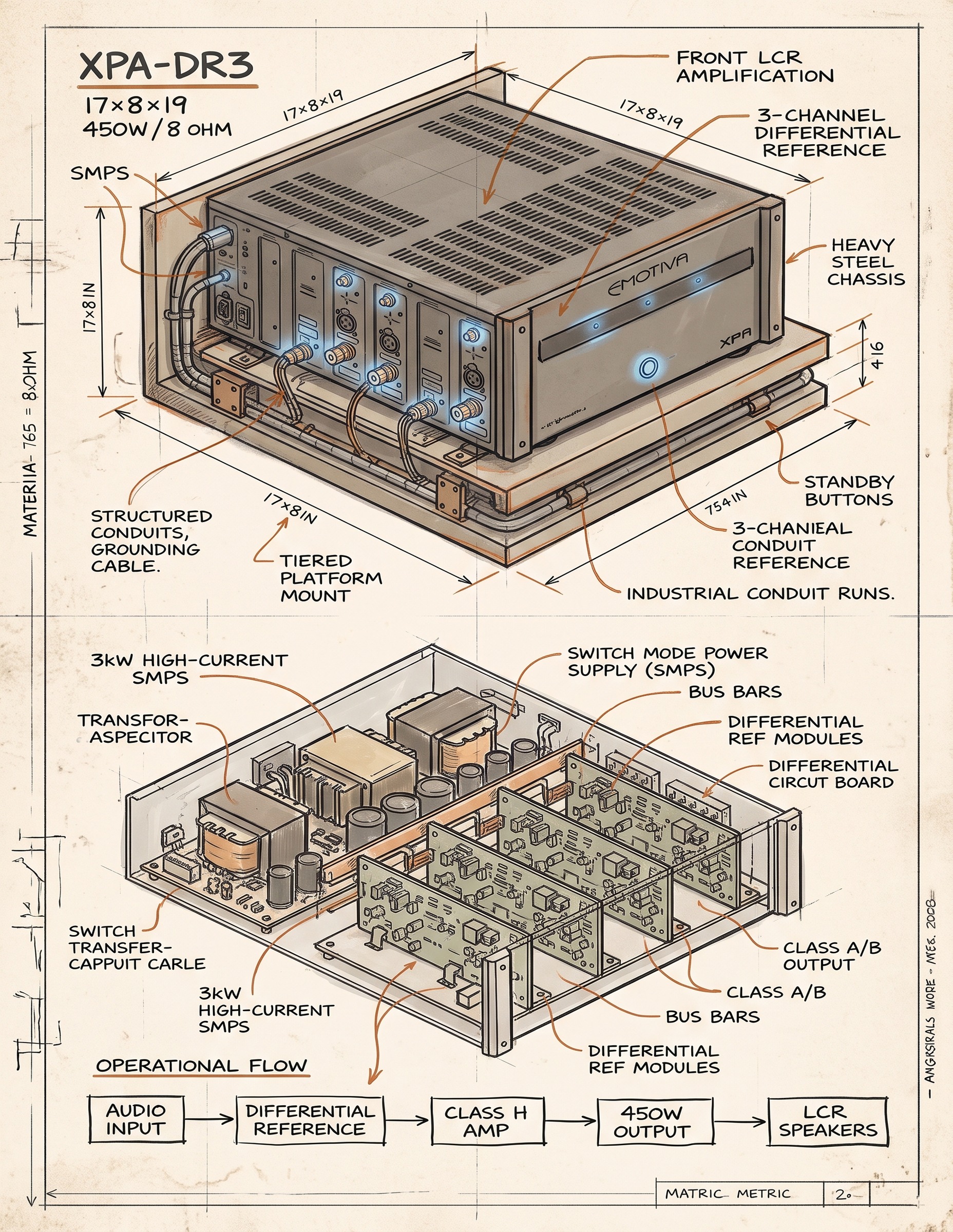
3-channel amplifier, 450W per channel into 8 ohms, differential reference, Class A/B.
Real-world facts
In multi-channel home theatre installations, the front soundstage carries more than seventy percent of the total acoustic energy during a cinematic soundtrack. Dialogue, primary musical scores and high-impact front sound effects place immense demands on the front left, centre and right channels. Recognizing that standard multichannel amplifiers often dilute power when multiple channels are driven simultaneously, Emotiva engineered the XPA-DR3 as a dedicated three-channel flagship solution[1]. The Differential Reference, or DR, amplifier line evolved directly from Emotiva's third-generation modular amplifier architecture first launched in 2016[2]. The XPA-DR3 was brought to market at CA3,600 by 2024 as component costs shifted, positioning itself as a high-value powerhouse for demanding audiophiles and cinema enthusiasts[1].
At the technical core of the XPA-DR3 are three independent Differential Reference amplifier modules[1]. Unlike conventional single-ended amplifier designs that drive a speaker using a single active signal wire referenced to an electrical ground, the DR3 utilizes two complete, matched amplifier stages working in balanced opposition for each individual channel[1]. One amplifier stage drives the positive speaker terminal while the second identical stage simultaneously drives the negative speaker terminal with an inverted signal[1]. This differential balanced topology doubles the slew rate, slashes harmonic distortion by cancelling out common-mode non-linearities and virtually eliminates ground loop hum[1]. Audioholics reviewed Emotiva's high-power architecture, noting that the amplifier delivers "dynamic ease and uncolored transparency"[2].
The electrical output capability of the XPA-DR3 is truly monumental. With all three channels driven continuously across the full audio bandwidth from 20 Hz to 20 kHz, the amplifier delivers 450 watts RMS per channel into 8-ohm loads at less than 0.1 percent total harmonic distortion[1]. When driving lower impedance 4-ohm speakers, that output rises to an astounding 600 watts RMS per channel[1]. Sound & Vision tested the platform and reported that "the dynamic headroom on the DR3 is simply staggering". This capability ensures that explosions, gunshot transients and orchestral peaks occur without any audible clipping or thermal compression. The wideband frequency response extends from 20 Hz to 50 kHz (+0/-2 dB), preserving delicate harmonic overtones and high-frequency acoustic details in high-resolution audio files[1].
Driving three high-current differential modules requires an electrical power plant capable of delivering immense energy on demand. Emotiva abandoned heavy, humming traditional toroidal transformers in favor of an engineered 3kW high-current switch-mode power supply, or SMPS[1]. This regulated power supply monitors incoming alternating current and dynamic speaker loads in real time, delivering steady rail voltages that never sag during sustained high-volume explosions[1]. To maximize electrical efficiency and minimize operating temperatures, Emotiva integrated its proprietary Soft-Switch Class H power supply topology[1]. Class H monitors the incoming audio signal continuously, keeping internal operating voltages low during quiet musical passages and instantly switching to high-voltage rails within microseconds when massive transient peaks arrive[1].
The physical chassis of the XPA-DR3 is built like commercial industrial machinery. The amplifier occupies a 4RU form factor measuring 17 inches wide, 8 inches high and 19 inches deep and weighs a substantial 49.5 pounds[1]. The heavy steel chassis is fronted by a solid milled aluminium faceplate finished in satin black, featuring Emotiva's signature blue status LEDs that indicate active channel operation and system health[1]. On the rear panel, each channel features a heavy-duty toggle switch to select between balanced XLR and unbalanced RCA inputs, alongside audiophile-grade gold-plated five-way binding posts capable of accepting heavy-gauge bare wire, spade lugs or banana plugs[1]. A 12-volt trigger input and output sync power sequencing with the preamplifier, while an integrated rear push-button circuit breaker replaces disposable fuses[1].
In practical field installations, veteran installers and forum contributors on AVForums share several crucial tips for managing the XPA-DR3[3]. Drawing upwards of 2,300 watts from the electrical wall outlet under full operational load, the amplifier should ideally be connected to a dedicated 20-amp, 120-volt household circuit rather than sharing power with domestic lighting or electronics[1]. While the Soft-Switch Class H circuitry allows the amplifier to run noticeably cooler than pure Class A or standard Class A/B designs, its three heavy modular heatsinks still generate substantial convective heat[1]. Installers recommend leaving at least two inches of clear ventilation space above and behind the chassis inside an equipment rack to allow convective airflow to circulate freely[3].
Specifications on the drawing
- 3-channel power amplifier: A dedicated multi-channel external power amplification unit designed specifically to deliver electrical current to the three front speakers: front left, centre and front right. By dedicating its entire internal power supply and chassis architecture exclusively to three channels, it guarantees that primary dialogue and front-stage cinematic action never suffer from power starvation during demanding sequences.
- 450W per channel into 8 ohms: The continuous Root Mean Square electrical power delivered to each connected speaker with an 8-ohm impedance rating across the full audible spectrum with all three channels driven simultaneously. This massive wattage provides limitless dynamic headroom, ensuring that transient audio spikes like gunshots or thunderclaps are reproduced without distortion or clipping.
- Differential Reference, Class A/B: A balanced internal amplifier topology pairing two identical, symmetrical Class A/B amplifier circuits in push-pull opposition for each channel. Class A/B combines the smooth, low-distortion audio quality of Class A with the energy efficiency of Class B, while the differential circuit layout cancels common-mode electrical noise and doubles the output slew rate.
- 3kW high-current switch-mode power supply: A regulated electronic power supply capable of delivering 3,000 watts of peak power with sustained 2,300-watt continuous output (sources vary: Emotiva factory specifications rate maximum continuous power draw at 2,300W with 3,000W short-term dynamic peak reserve). This switch-mode supply replaces massive, heavy toroidal transformers with high-frequency switching circuits, ensuring that internal power rail voltages remain rock solid during sustained explosions without sagging.
- 17 x 8 x 19 inches: The physical external dimensions of the heavy steel and aluminium amplifier chassis, conforming to a standard 4RU vertical rack height. This substantial footprint and 19-inch depth demand a heavy-duty, deep professional equipment rack with ample clearance for heavy speaker cables, thick power cords and convective cooling airflow.
Sources
- Emotiva Audio, XPA-DR3 Differential Reference Three-Channel Power Amplifier Specifications
- Audioholics, Emotiva Amps and Processors at the Audioholics Get Together
- AVForums, Power Amp Advice and Heat Management
Product page: Emotiva