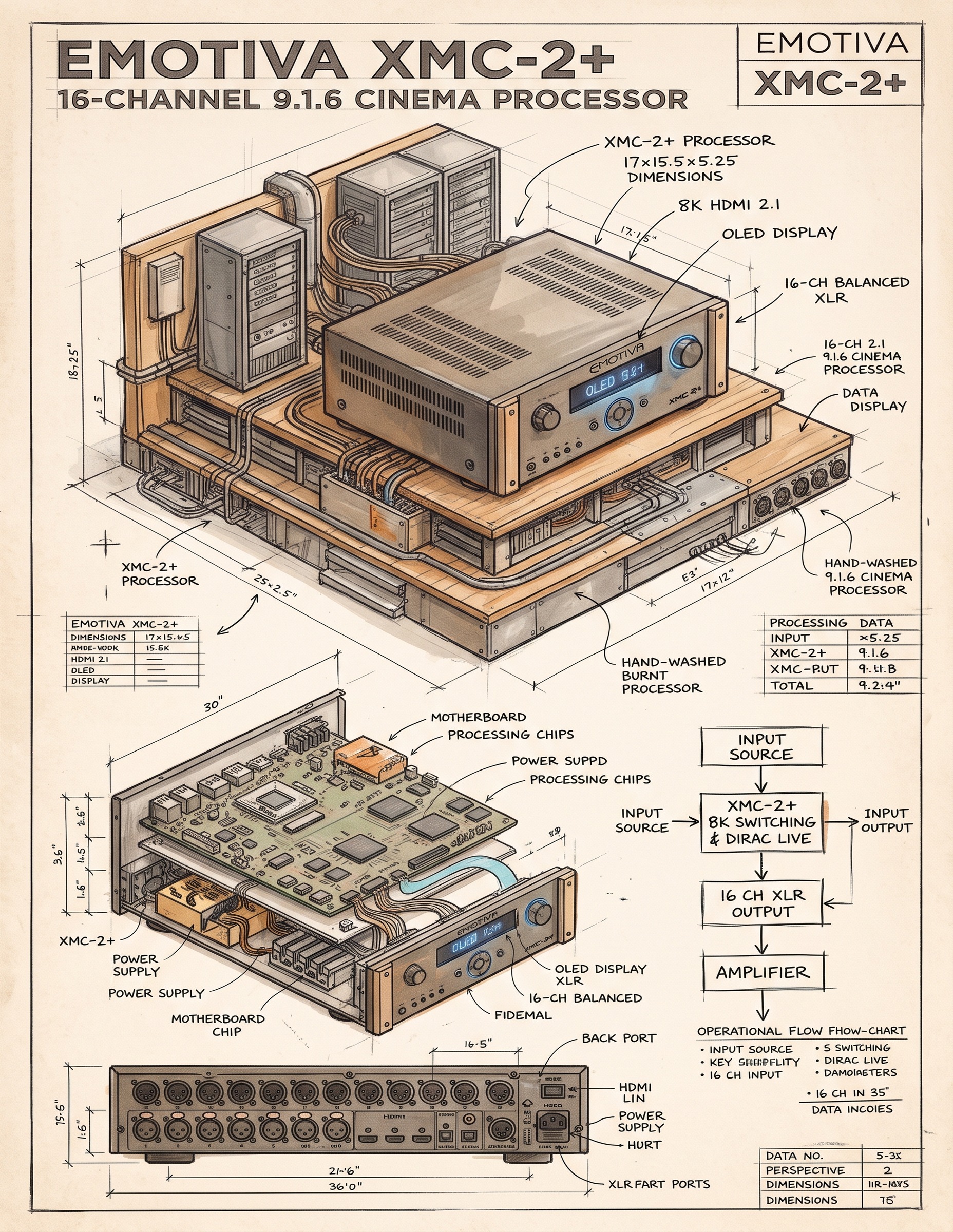
16-channel 9.1.6 cinema processor with 8K HDMI 2.1 and 16-channel balanced XLR outputs.
Real-world facts
In the high-end private cinema market, separate processing components stand distinct from all-in-one receivers by dedicating every circuit to pure signal decoding and routing. Emotiva established its reputation by challenging luxury brands with high-performance audio separates at direct-to-consumer pricing. The development path toward the XMC-2+ began in 2014 with the landmark XMC-1, which first introduced audiophiles to fully balanced stereo architecture and automated room correction at an accessible price point[1]. Building on that platform, Emotiva unveiled the original XMC-2 in 2019 at CA6,500 RMC-1 processor[2]. To meet the modern demands of high-framerate gaming and ultra-high-definition video, Emotiva rolled out the upgraded XMC-2+ series in 2024 for CA$5,200, incorporating an entirely overhauled digital video switching infrastructure[3].
The core digital processing brain of the XMC-2+ decodes 16 discrete audio channels, handling advanced immersive layouts including 9.1.6 Dolby Atmos and DTS:X Pro[3]. Unlike traditional consumer receivers that share processing channels or downmix height layers, the XMC-2+ renders every sound object to its exact spatial coordinate across nine bed channels, one subwoofer track and six discrete overhead ceiling channels[3]. Audio decoding is driven by Analog Devices dual-core DSP chips that preserve multi-channel phase relationships without audible dynamic compression. For legacy two-channel stereo listening, an all-analogue Reference Stereo mode bypasses all digital signal processing and conversion stages entirely, routing pure analogue signals directly through resistor-ladder volume controls to preserve pristine stereo imaging[3].
Digital-to-analogue conversion is handled by premium 32-bit AKM AK4490 Velvet Sound DAC chips operating in fully balanced differential mode for the primary channels[3]. Audioholics reviewed the underlying architecture of Emotiva's 16-channel platform, remarking that it produces "exceptional audio performance with tremendous dynamic range" across complex soundtracks. The processor achieves a signal-to-noise ratio exceeding 115 dB, ensuring that silent movie scenes remain dead quiet without hiss or background hum through sensitive high-efficiency loudspeakers[3]. The rear input panel hosts a full complement of balanced AES/EBU digital audio, optical Toslink and coaxial digital inputs, alongside an array of analogue RCA connectors for vintage source equipment[3].
Video switching on the XMC-2+ represents a massive leap over previous generations with the factory installation of an 8K HDMI 2.1 interface board[3]. All primary HDMI input ports support full 48 Gbps data bandwidth, passing 8K video at 60 Hz and 4K high-frame-rate video at 120 Hz with uncompressed 4:4:4 colour sampling[3]. The unit maintains full compatibility with modern high dynamic range standards, including HDR10, HDR10+, Dolby Vision and dynamic frame-rate enhancements like Variable Refresh Rate and Auto Low Latency Mode[3]. On AVS Forum, owners praise the updated HDMI 2.1 board for resolving historical handshake delays, noting that video switching locks onto signals significantly faster than the earlier HDMI 2.0b revision[4].
A cornerstone of the XMC-2+ system is its integration of a full-bandwidth licence for Dirac Live room correction[3]. Dirac Live measures the acoustic output across all 16 channels, using impulse-response and frequency-domain algorithms to correct room acoustic anomalies and speaker phase misalignments[3]. The processor includes a calibrated omnidirectional measurement microphone that connects directly to a computer running the Dirac software suite[3]. Sound & Vision has praised Dirac Live for its ability to "tighten mid-bass slam and eliminate vocal smearing" caused by early room reflections. The processor allows users to store up to three completely independent speaker preset configurations, letting listeners switch between dedicated cinema target curves, music curves or uncalibrated direct modes with a single button press[3].
Physical construction reflects commercial studio standards, featuring a heavy 3RU steel chassis with a milled solid aluminium front bezel[3]. An ultra-crisp blue OLED graphic display on the front face provides real-time readout of input formats, decoding codecs, volume levels and menu configurations without emitting excessive ambient light into a darkened room[3]. Measuring 17 inches wide, 15.5 inches deep and 5.25 inches high, the unit fits into standard 19-inch audio racks using optional rack-mount ears[3]. Long-time owners on home cinema forums recommend assigning a static IP address to the processor over its wired Ethernet port, which enables fast app control from smartphones and tablets while bypassing standard remote control latency[4].
Specifications on the drawing
- 16-channel 9.1.6 cinema processor: A dedicated surround sound decoding unit that processes up to 16 discrete audio channels, arranged as nine surround bed speakers, one subwoofer track and six overhead height speakers. This allows complex movie soundtracks to position sound objects with exact three-dimensional realism throughout the entire room airspace. It eliminates channel sharing or downmixing, ensuring that every speaker in a modern Dolby Atmos or DTS:X Pro installation receives an independent acoustic stream.
- 8K HDMI 2.1: The modern high-bandwidth digital video interface standard operating at up to 48 gigabits per second. It allows pristine passthrough of 8K resolution video at 60 frames per second and 4K gaming at 120 frames per second alongside high dynamic range formats like Dolby Vision. This bandwidth headroom ensures the processor handles current next-generation gaming consoles and future ultra-high-definition video sources without clipping image data or introducing transmission latency.
- 16-channel balanced XLR outputs: Professional-grade three-pin audio connectors that transmit analogue audio over balanced differential signal wires. This connection cancels external electromagnetic and radio-frequency noise over long cable runs from the processor to power amplifiers. It guarantees the absolute lowest noise floor and maximum dynamic headroom when feeding power-hungry multi-channel power amplifiers.
- OLED display: An organic light-emitting diode screen located on the front panel that illuminates individual pixels without a distracting continuous backlight. It provides clear, high-contrast operational readouts during movie playback while preventing distracting light glow inside a pitch-black theatre room. The graphic panel displays incoming audio bitstreams, sampling rates and volume adjustments with razor-sharp text that remains legible across a wide viewing arc.
- 17 x 15.5 x 5.25 inches: The physical chassis dimensions of the processor without rack ears attached, conforming to a standard 3RU height profile. These standardized proportions ensure straightforward integration onto shelves or mounting rails within standard 19-inch equipment racks. The compact 15.5-inch depth leaves ample breathing room behind the chassis for heavy balanced XLR cables and structured network connections.
Sources
- Sound & Vision, Emotiva XMC-1 Surround Processor Review
- Audioholics, DTS:X Pro Forum Discussion
- Audio Affair, Emotiva XMC-2+ 16 Channel AV Processor Specifications
- AVS Forum, Emotiva RMC-1+, RMC-1L+ and XMC-2+ Processor Thread
Product page: Emotiva