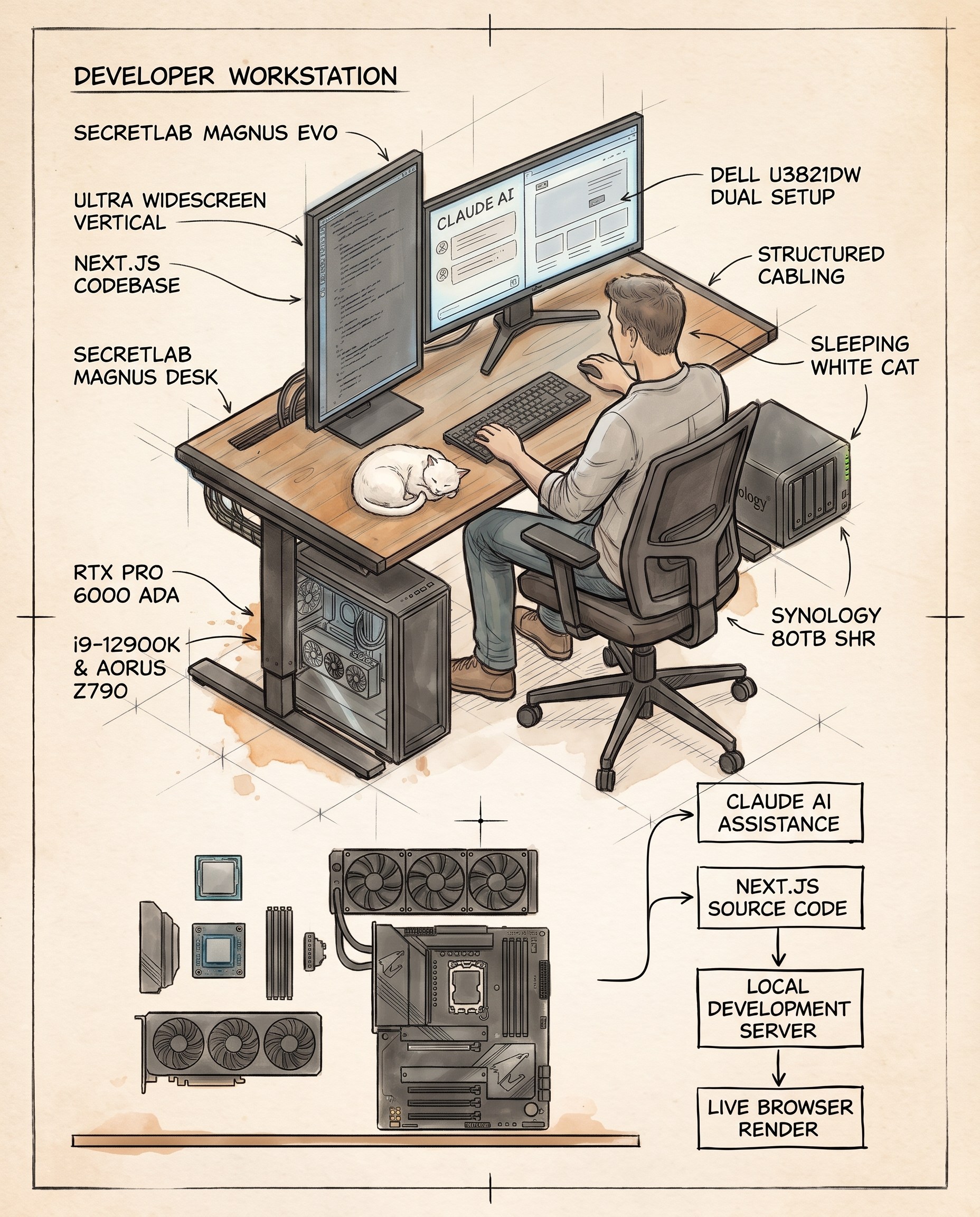
Secretlab Magnus desk, ultra-widescreen horizontal and vertical monitors, structured cabling, a Next.js codebase and a white desk cat.
Real-world facts
A modern software engineering environment relies on ergonomic furniture, specialized visual ergonomics and high-throughput computational hardware to sustain deep development workflows. This is the desk where mano.com.ph, ais.ph and many other systems were built, anchored by the Secretlab Magnus Pro desk and matching ergonomic chair[1]. Secretlab launched the Magnus Pro in 2022 starting at CA$1,059, evolving its earlier static Magnus desk into an integrated motorized sit-to-stand steel platform[1]. Fabricated from solid steel beams with a dual-motor electric lifting column, the desk supports up to 100 kilograms of hardware while concealing a full-length rear cable management tray covered by a hinged leatherette lid[1]. It incorporates an integrated power supply column routed inside the lower leg, allowing a single heavy-gauge electrical cord to deliver AC power directly to an integrated power strip inside the rear tray[1].
The visual display setup utilizes dual Dell UltraSharp U3821DW curved monitors arranged in an asymmetric dual-orientation configuration: one horizontal and one vertical[2]. Released by Dell in early 2021 at an initial price of CA$1,899, the U3821DW features a 37.5-inch IPS display with an ultrawide 21:9 aspect ratio and a native resolution of 3840 by 1600 pixels[2]. PCMag reviewed the U3821DW, noting that "its vast screen real estate and integrated USB hub make it a productivity dream"[2]. Positioning the primary monitor horizontally provides expansive horizontal space for timeline navigation, multi-column code views and terminal windows without window overlapping[2]. Mounting the secondary 38-inch ultrawide vertically creates a colossal vertical viewport that displays hundreds of continuous lines of code, log streams or technical documentation without scrolling.
Structured cabling transforms a complex workstation from a chaotic nest of cords into an organized, interference-free workspace[1]. By utilizing the magnetic cable anchors, modular cable sheaths and full-length under-desk channel of the Magnus desk, power cords and high-speed data cables are physically separated[1]. This structural containment prevents electrical interference between high-wattage power bricks and unshielded audio or display cables, while keeping the floor surface completely clear[1]. Resting beside the keyboard is the resident companion of the workstation: the white desk cat is CC, 9 years old, found on the street outside a restaurant called Terry's and brought to Canada.
The local computational backbone is a custom-engineered workstation PC designed for demanding compilation and local artificial intelligence workloads. At its centre is the Intel Core i9-12900K processor, featuring 16 cores and 24 threads running on Intel's Alder Lake hybrid architecture[3]. Thermal dissipation is managed by a 240mm all-in-one liquid cooler from NZXT, which pumps liquid coolant across copper micro-fins to keep the 241-watt processor within safe operational temperatures during heavy multithreaded compilation tasks[3]. The system is built upon a Gigabyte Aorus Z790 motherboard, providing high-bandwidth PCIe 5.0 expansion lanes, multi-gigabit networking and ultra-fast DDR5 memory bandwidth[4].
Graphics and neural processing duties are driven by an enterprise-grade Asus NVIDIA RTX 6000 Ada Generation GPU, installed in a vertical mounting bracket to maximize airflow and prevent motherboard slot sagging[5]. Equipped with 48 gigabytes of error-correcting GDDR6 VRAM and 18,176 CUDA cores, the workstation card excels in rendering 3D graphics, local large language model inference and hardware-accelerated machine learning tasks[5]. Mass storage and continuous data redundancy are offloaded to an external network-attached storage array: a Synology 8-bay DiskStation populated with 80 terabytes of raw storage configured in a Synology Hybrid RAID, known as SHR[6]. This hybrid RAID array protects data against single or dual drive failures while optimizing storage volume across mixed drive capacities[6].
Modern web application development on this workstation leverages Next.js, an open-source React framework created by Vercel[7]. Next.js enables developers to build full-stack web applications by combining server-side rendering, static site generation and client-side React hydration into a unified architecture[7]. In this modern development loop, software engineers pair Next.js with artificial intelligence coding assistants like Anthropic's Claude to accelerate software architecture and component design[8]. Developers feed complex component specifications or TypeScript schemas into Claude, which generates modular Next.js route handlers, responsive Tailwind styling and accessible React components[8].
The local development workflow follows a rapid, iterative feedback loop: Next.js source code is edited locally, the local development server hot-reloads modules in real time, and the live browser render updates instantaneously on the ultrawide display[7]. This tight development loop eliminates manual rebuilding steps, allowing developers to craft responsive, production-ready web platforms like mano.com.ph with exceptional agility[7].
Specifications on the drawing
- Secretlab Magnus Evo desk and Chair: A heavy-gauge steel workstation desk and ergonomic seating platform engineered with an integrated motorized sit-to-stand lifting mechanism and magnetic accessories (sources vary: Secretlab commercially markets this motorized standing model as the Magnus Pro, while early design blueprints designate it as the Magnus Evo). The desk incorporates a full-length rear cable management tray with a hinged cover and an internal leg power column, providing a rigid, clutter-free foundation that supports heavy dual-monitor arms and computing hardware without mechanical wobbling.
- Dual Ultra-widescreen monitors, one horizontal and one vertical: A pair of 37.5-inch Dell UltraSharp U3821DW curved displays featuring a 21:9 aspect ratio and 3840 by 1600 resolution, oriented perpendicularly to maximize specialized desktop workspace. The horizontal screen provides an uninterrupted wide panoramic timeline for multitasking, browser inspection and multi-pane code editors, while the vertical display creates an expansive continuous view for reading long files of source code, terminal logs and technical documentation without continuous mouse scrolling.
- Structured cabling: A concealed wire routing infrastructure utilizing magnetic cable guides, modular under-desk channels and dedicated power conduits to separate high-voltage alternating current lines from low-voltage digital data signals. This rigorous routing prevents electromagnetic signal degradation, protects delicate USB and display cables from physical pinching and maintains a clean, minimalist workstation environment.
- Flow: Next.js source code, local development server, live browser render: The iterative software development loop where source code written in a local text editor is continuously compiled by the Next.js local development server and reflected via Fast Refresh in the live browser preview. This rapid hot-reloading architecture allows developers using AI thought partners like Claude to write, test and refine responsive web interfaces and API routes instantaneously without manual compilation delays.
- Computer with i9 12900K with a 240MM AIO NZXT Cooler, Auros Z790 Motherboard, Asus RTX Pro 6000 ADA vertically mounted connected to a Synology 8-Bay Diskstation with 80TB of Disk space in a Synology Hybrid Raid: A high-performance workstation PC featuring a 16-core Intel Core i9 processor liquid-cooled by a 240mm radiator, an Aorus Z790 motherboard and a vertically oriented 48GB Asus RTX 6000 Ada GPU, networked directly to an 8-bay Synology NAS configured with 80TB in Synology Hybrid RAID. This computational powerhouse provides instantaneous local code compilation, massive multi-threaded processing and enterprise-grade GPU acceleration for artificial intelligence workloads, while the redundant 80TB network storage array safeguards project repositories and media archives against hardware drive failures.
Sources
- Secretlab, Secretlab MAGNUS Pro Sit-to-Stand Metal Desk Specifications
- PCMag, Dell UltraSharp 38 Curved USB-C Hub Monitor (U3821DW) Review
- AnandTech, Intel Core i9-12900K Alder Lake Architecture Review
- Gigabyte, Z790 AORUS ELITE AX Specifications and Motherboard Layout
- NVIDIA, NVIDIA RTX 6000 Ada Generation Professional Graphics Card Architecture
- Synology, What is Synology Hybrid RAID (SHR)?
- Vercel, Next.js Documentation and Architecture Overview
- Anthropic, Claude Model Overview and AI Developer Workflows
Product page: Secretlab