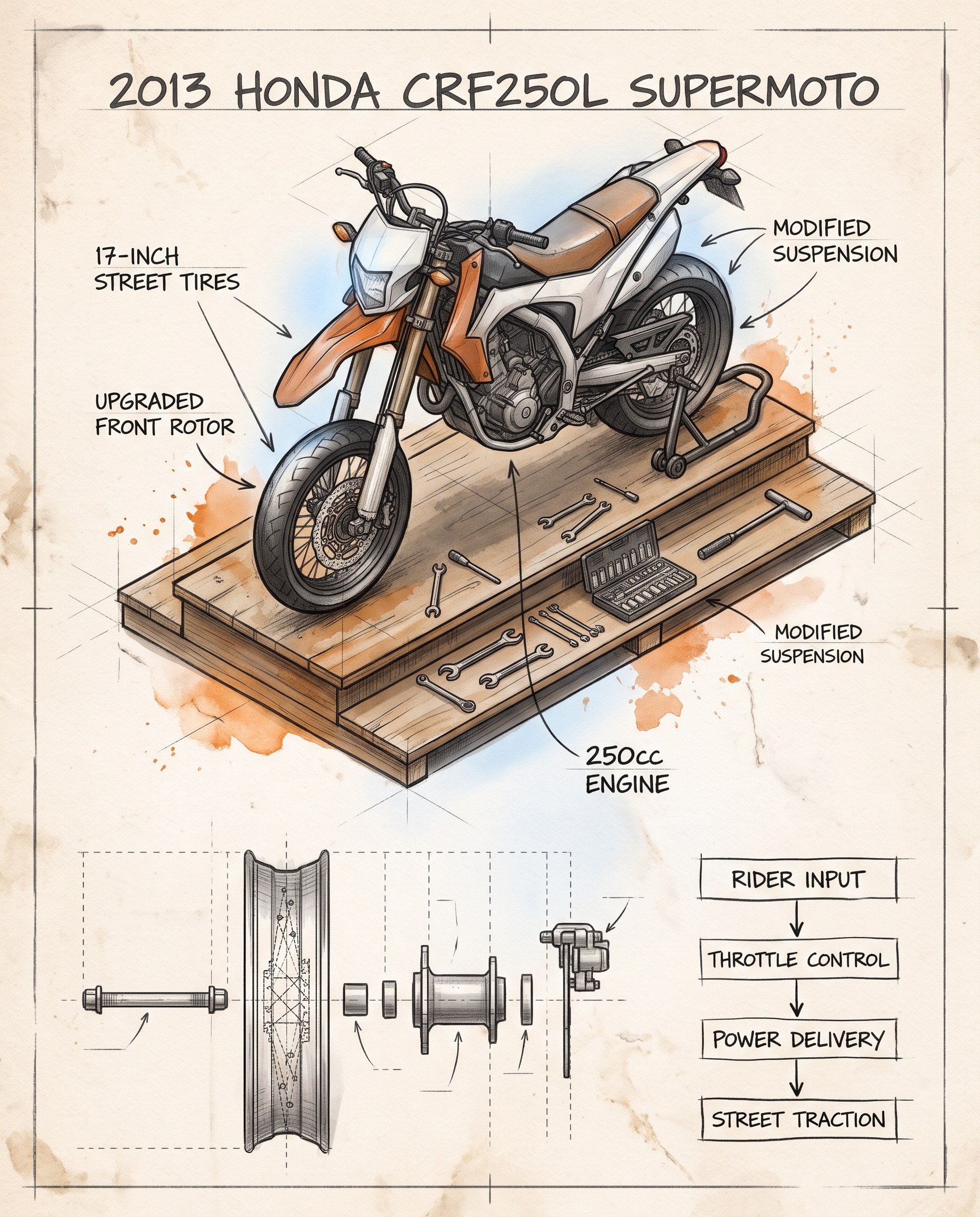
A 2013 CRF250L turned supermoto: 17-inch street tires, an upgraded front rotor, modified suspension and a tuned 250cc engine for the street.
Real-world facts
Dual-sport motorcycles have long offered an accessible bridge between unpaved trail riding and daily street transportation. In April 2012, Honda revived its quarter-litre dual-sport heritage by launching the 2013 CRF250L at an aggressive Canadian retail price of CA$4,999 in 2012. Built in Thailand to optimize production efficiency, the CRF250L arrived as the practical, modern successor to air-cooled thumpers like the legendary XR250R. It combined long-travel off-road suspension with liquid cooling and digital fuel injection, meeting strict global emissions standards while providing bulletproof everyday reliability. However, its modest horsepower, heavy steel chassis and soft suspension led an enthusiastic subculture of riders to transform the mild dual-sport into an agile, street-hooligan supermoto.
In showroom stock trim, the 2013 CRF250L is engineered for casual trail exploration and gentle commuting. Its heart is a 249.6cc liquid-cooled, double overhead cam, four-valve single-cylinder engine borrowed and re-tuned from the CBR250R sportbike. Featuring Honda's Programmed Fuel Injection, or PGM-FI, with a 36 mm throttle body, the stock motor produces 22.8 horsepower at 8,500 rpm and 16.2 foot-pounds of torque at 7,000 rpm. The stock running gear features off-road wheel dimensions: a 21-inch spoked aluminium rim up front and an 18-inch rim at the rear, fitted with knobby dual-sport tires. The stock suspension uses a non-adjustable 43 mm Showa inverted fork with 250 mm of travel and a Pro-Link single rear shock with 240 mm of travel. Motorcycle News tested the stock bike and remarked that "it is a friendly, accessible dual-purpose machine that excels in the city"[1].
Despite its friendly nature, the stock CRF250L exhibits noticeable handling compromises when ridden hard on paved roads. The tall 21-inch front wheel slows down steering response, while the knobby dual-sport tires squirm under aggressive cornering loads. More critically, the stock Showa fork is under-sprung and lightly damped, causing the front end to dive violently during hard braking and wallow through mid-corner bumps. The modest 256 mm front brake disc provides adequate stopping power in loose dirt, but lacks the aggressive friction bite and heat dissipation required for spirited asphalt riding. At 145 kilograms, or 320 pounds ready to ride, the stock bike carries substantial heft for a quarter-litre machine.
Converting the CRF250L into a supermoto fundamentally reinvents the motorcycle's handling geometry and dynamic personality. The transformation begins by replacing the stock dirt rims with wide 17-inch spoked supermoto wheels, typically running a 3.00-inch wide front rim wrapped in a 110/70-17 street sport tire and a 4.25-inch wide rear rim supporting a 140/70-17 or 150/60-17 radial tire. Dropping from a 21-inch to a 17-inch front wheel lowers the front axle by approximately two inches, steepening the steering rake angle and shortening trail. This reduction in gyroscopic wheel inertia transforms steering, allowing the motorcycle to change direction with lightning agility. Cycle World evaluated the supermoto conversion philosophy, stating that "it turns an ordinary trail bike into an urban assault vehicle".
I rode this specific converted 2013 Honda CRF250L for several years across Vancouver's dense grid and coastal switchbacks, experiencing how dramatically the modifications elevated its performance. To support the immense mechanical grip of modern street tires, the suspension requires substantial internal stiffening. Up front, installing heavy-rate Race Tech fork springs and Gold Valve cartridge emulators eliminates brake dive, keeping the chassis level when trailing brakes into corners. In the rear, replacing the soft stock shock with an aftermarket unit, such as an Öhlins or YSS remote-reservoir shock, provides proper spring preload and adjustable rebound damping. Stopping power is upgraded by fitting a massive 320 mm floating front brake rotor on an offset caliper relocation bracket, giving the stock twin-piston caliper immense leverage to haul down the bike on tarmac.
Engine tuning wakes up the previously sleepy 250cc powerplant to match the athletic chassis[2]. Enthusiasts on ThumperTalk and CRF250L Owners Club routinely install an Electronic Jet Kit, or EJK fuel controller, to richen up the factory lean air-fuel mixture[2]. Pairing this fuel tuner with an aftermarket FMF Powercore 4 slip-on exhaust, a MegaBomb header pipe and removing the restrictive airbox snorkel unlocks roughly 3 to 4 additional horsepower, sharpening throttle response and filling in the flat mid-range[2]. Furthermore, because the smaller 17-inch wheels spin faster and throw off the factory digital speedometer by over 12 percent, owners install a 12 O'Clock Labs SpeedoDRD calibration chip to restore accurate road speed and odometer tracking[2].
Specifications on the drawing
- 17-inch wheels: Lightweight 17-inch aluminium spoked rims laced to reinforced hubs, replacing the factory 21-inch front and 18-inch rear off-road wheel combination. This downsized diameter lowers the overall centre of gravity, steepens steering geometry and allows the fitment of wide, sticky sport-compound radial tires for extraordinary pavement grip. It slashes rotational gyroscopic inertia, allowing the motorcycle to drop into tight hairpins and transition side to side with immediate agility.
- Frame: The factory twin-spar steel perimeter chassis featuring an integrated semi-double cradle and an extruded aluminium swingarm. While heavier than exotic alloy racing frames, this robust steel structure provides immense structural rigidity and high torsional strength that effortlessly handles the increased cornering loads and braking stresses generated by sticky street tires. It acts as an indestructible structural backbone that absorbs high-frequency road chatter without transferring vibrations to the rider.
- Suspension tuning: Re-valved and stiffened front and rear damping systems, featuring heavy-rate progressive fork springs, cartridge emulators and an aftermarket adjustable rear shock absorber. In stock trim, the soft, long-travel off-road suspension dives violently under heavy front braking and wallows through paved corners. This bespoke tuning raises high-speed damping resistance, holding the chassis flat and stable under aggressive trail-braking while maintaining tire contact over rough asphalt.
- Engine tuning: A comprehensive powertrain optimization package including an Electronic Jet Kit fuel controller, a high-flow exhaust system, free-flowing airbox modifications and revised final-drive sprocket ratios. The stock motor is restricted by ultra-lean factory fuel maps and quiet, restrictive baffles designed for gentle trail commuting. These tuning enhancements optimize fuel-air atomization, extracting additional mid-range horsepower and crisp, immediate throttle response that lets the small-displacement engine pull eagerly out of slow corners.
Sources
- Motorcycle News, Honda CRF250L (2012-2020) Review
- ThumperTalk, CRF250L Supermoto Conversion Thread
Product page: Honda