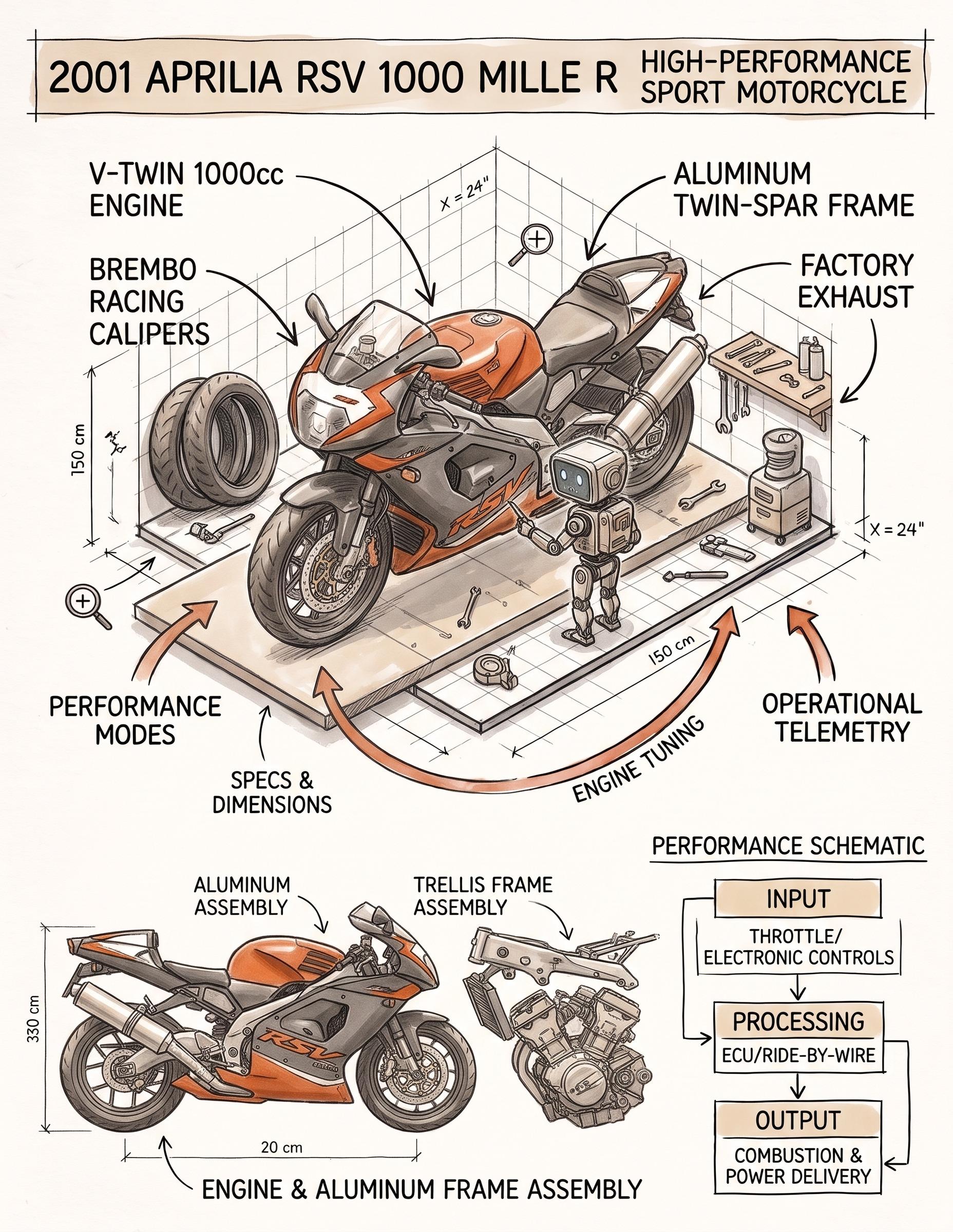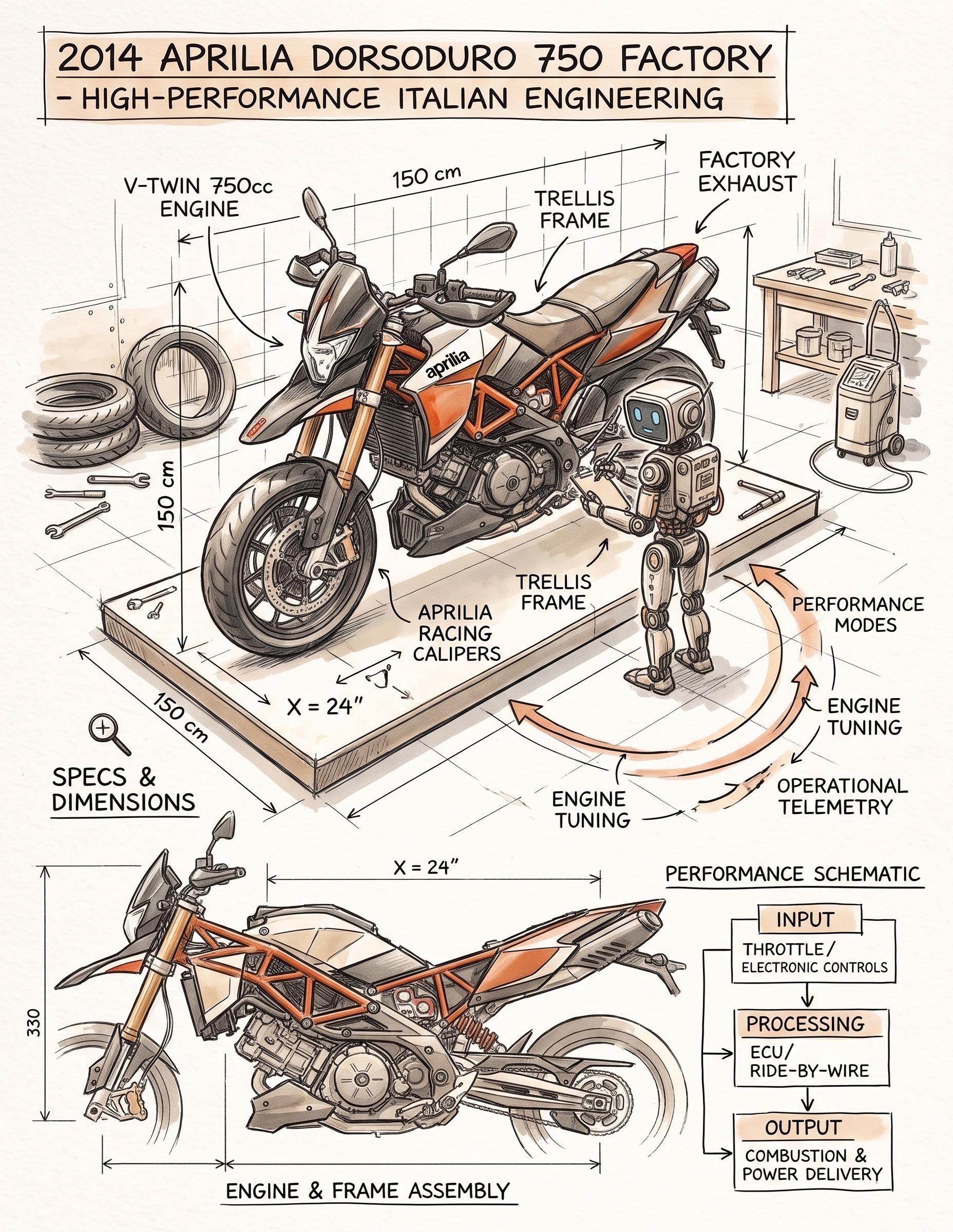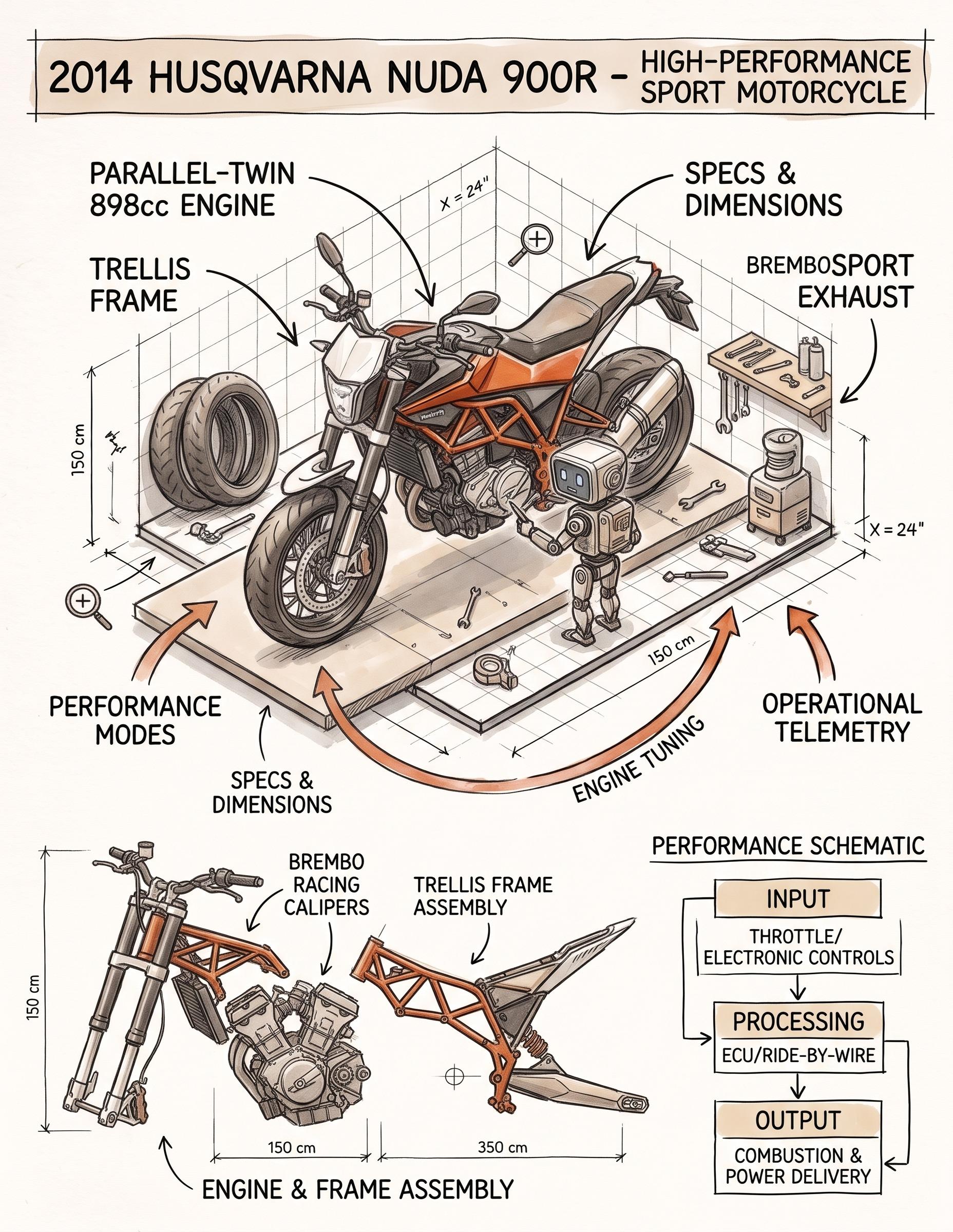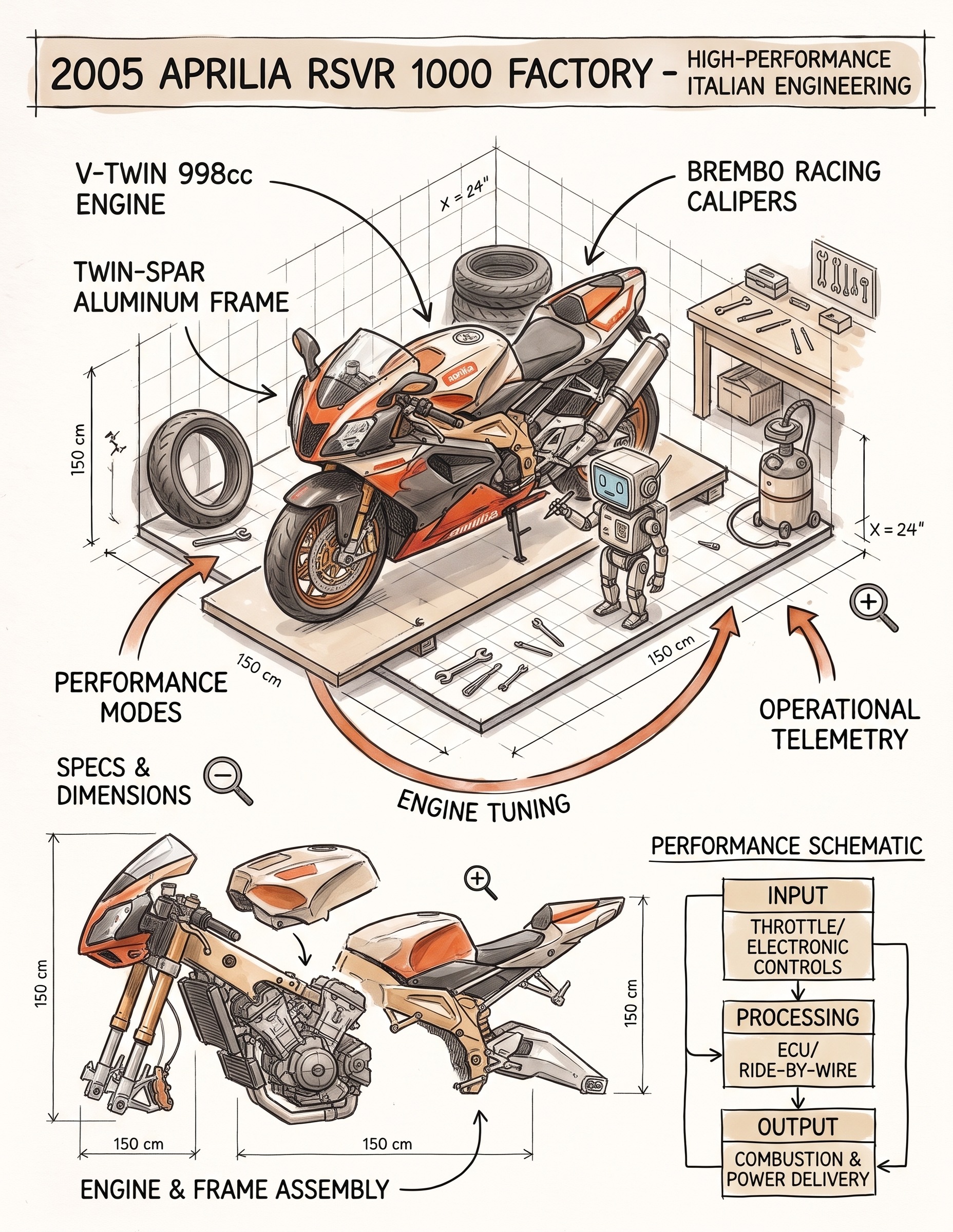
V-twin 998cc, Brembo racing calipers and a twin-spar aluminum frame.
Real-world facts
In late 2003, Aprilia unveiled the second-generation iteration of its superbike platform, rebranding the machine as the RSV 1000 R and elevating its top-tier race replica as the Factory model. By the 2005 production year, the Aprilia RSVR 1000 Factory had matured into one of the most refined and exotic twin-cylinder superbikes in the world, carrying an original Canadian retail price of CA$22,995[1]. The Factory designation stood as Aprilia's unapologetic rolling showcase of lightweight carbon fibre, forged alloy metallurgy and top-shelf Swedish suspension components. It was conceived not merely to compete with Ducati's 999 on the street, but to deliver a focused, track-ready chassis that demanded minimal preparation for racing.
Powering the 2005 RSVR Factory is the heavily revised V990 Magnesium 60-degree V-twin engine, displacing 998cc. Compared to the earlier Mille motor, the Magnesium edition featured lighter magnesium valve covers and clutch casings, larger 38 mm exhaust valves, high-lift camshaft profiles and a modern Siemens SAGEM digital electronic fuel injection system. Fuel delivery flowed through 57 mm throttle bodies fed by a central dynamic ram-air intake channel routed directly through the nose cone. This updated engine produced a claimed 138 horsepower at 9,500 rpm and 79 foot-pounds of torque at 7,500 rpm, delivering a wider, more eager powerband that revved faster to its redline than the first-generation block. Motorcycle News reviewed the machine and observed that "the engine is a peach, smooth, powerful and full of character". The inclusion of Aprilia's Pneumatic Power Clutch, or PPC, used manifold vacuum under deceleration to mechanically relieve clutch spring pressure, preventing destructive rear-wheel chatter during aggressive downshifting.
I rode this 2005 Aprilia RSVR 1000 Factory for several years, logging thousands of kilometres over twisting coastal mountain highways. The motorcycle relies on an all-new twin-spar aluminium frame, which Aprilia redesigned to lower the engine position within the chassis by several millimetres to drop the centre of gravity. The chassis beams are finished in a signature lustrous gold-anodized coating on the Factory trim, paired with an inverted, high-rigidity gull-wing double banana aluminium swingarm that remains an architectural masterpiece of structural casting. The suspension package is entirely sourced from Öhlins, comprising a 43 mm fully adjustable titanium-nitride inverted fork up front, an Öhlins fully adjustable rear shock absorber with remote reservoir, and a transverse Öhlins steering damper mounted just beneath the lower triple clamp.
Braking duties on the 2005 Factory represented a leap forward in racing technology with the integration of Brembo Triple Bridge radial-mount calipers. These four-piston monobloc calipers bolt directly to stiff radial cast lugs on the lower Öhlins fork stanchions, clamping floating 320 mm stainless steel discs through four individual brake pads per caliper. Radial mounting eliminates the torsional twisting and flexing common to conventional axial calipers under high brake loads, providing surgical lever modulation and immediate initial bite. Visordown evaluated the Factory, calling it "an exquisite handling masterpiece with serious soul". Unsprung rotating weight was minimized by fitting forged aluminium OZ Racing wheels finished in electric blue, shedding unsprung weight to accelerate side-to-side transitions.
Weight reduction and premium aesthetic finishes defined the Factory model's carbon-clad bodywork. Genuine lightweight autoclave carbon fibre formed the front mudguard, rear tire hugger, fairing side extractors, fuel tank covers and cockpit air intake shrouds. Unlike the single high canister on the earlier Mille, the 2005 RSVR featured a symmetrical dual stainless steel exhaust system with high-mounted twin oval silencers emerging beneath the sharp passenger seat cowl. The motorcycle tipped the scales with an official dry weight of 185 kilograms, or 407 pounds (sources vary: some factory spec sheets state 189 kg dry weight) [1, 2].
Maintaining an RSVR Factory over the long term requires vigilant attention to a few known electrical and mechanical vulnerabilities[2]. Members of the Aprilia community identify the permanent-magnet charging rotor as a notorious trouble spot[2]. The stock rotor generated excessive magnetic flux that overheated the internal stator coils and melted the notorious brown wiring connector between the stator and the voltage regulator[2]. Experienced owners routinely replace the connector with direct soldered wires or install upgraded 370W rotor kits and series-type regulators to preserve electrical reliability[2]. Furthermore, the rear brake caliper, hung upside down below the swingarm, is notoriously difficult to bleed, requiring owners to unbolt the caliper and suspend it vertically during fluid service to expel trapped air bubbles[2].
Specifications on the drawing
- V-twin 998cc engine: The second-generation 60-degree liquid-cooled V990 Magnesium motor featuring lightweight magnesium engine covers, enlarged 38 mm exhaust valves and twin 57 mm throttle bodies. It delivers 138 horsepower with linear mid-range torque, offering explosive drive out of corners while revving out cleanly to a 10,500 rpm ceiling. This narrow engine geometry centralizes mechanical mass to allow aggressive, quick directional changes without fighting gyro stability. The power delivery gives the rider predictable rear-wheel traction on corner exits, turning throttle twists into instantaneous forward momentum.
- Brembo racing calipers: Radially mounted four-piston Triple Bridge hydraulic front calipers clamping onto dual 320 mm floating stainless steel brake discs with four independent pads per caliper. The radial mounting bolts fasten parallel to the wheel rotation axis, eliminating caliper flex under extreme track braking to provide unmatched lever precision. This allows the rider to trail-brake deep into corners with total confidence that braking force will not deform or fade. By isolating each piston with a separate friction pad, heat dissipation is accelerated and pad wear remains completely uniform across the track session.
- Twin-spar aluminium frame: A high-rigidity chassis engineered from cast and extruded aluminium alloy spars, coated in a distinctive gold-anodized finish on the Factory edition. It cradles the engine lower in the chassis to reduce the centre of gravity and increases torsional stiffness for absolute line-holding stability through fast, sweeping bends. This structural design isolates chassis flex from the suspension, allowing the Öhlins dampers to absorb surface imperfections without unsettling the rider's trajectory. It ensures that steering inputs translate directly into wheel placement with zero lag or frame twisting.
Sources
- MotoPlanete, Aprilia RSV-R 1000 2005 Technical Overview and Pricing
- NastyNils, RSV 1000 R Factory (MY2005) Buying Guide and Common Gremlins
Product page: Aprilia